






 9NQ7
9NQ7
Cryo-EM structure of Csm/AcrIIIA2/enolase 4:3 complex
Summary for 9NQ7
| Entry DOI | 10.2210/pdb9nq7/pdb |
| EMDB information | 49593 49645 |
| Descriptor | RNA (41-MER), CRISPR system Cms protein Csm5, CRISPR system single-strand-specific deoxyribonuclease Cas10/Csm1 (subtype III-A), ... (8 entities in total) |
| Functional Keywords | anti-crispr, type iii crispr, cryo-em, structural bioloy, anti-bacterial, rna binding protein |
| Biological source | Streptococcus thermophilus More |
| Total number of polymer chains | 20 |
| Total formula weight | 709773.40 |
| Authors | Goswami, H.N.,Li, H. (deposition date: 2025-03-11, release date: 2025-11-12, Last modification date: 2026-07-29) |
| Primary citation | Johnson, K.A.,Goswami, H.N.,Catchpole, R.J.,Ahmadizadeh, F.,Zhao, P.,Wells, L.,Li, H.,Terns, M.P. A phage-encoded anti-CRISPR protein co-opts host enolase to prevent type III CRISPR immunity. Nat Microbiol, 10:3162-3175, 2025 Cited by PubMed Abstract: CRISPR (Clustered Regularly Interspaced Short Palindromic Repeats) systems provide powerful adaptive immunity against phage infection. In response, phages use anti-CRISPR (Acr) proteins to evade CRISPR immunity. The few type III Acrs identified so far show conditional effectiveness in countering type III immunity or rely on unknown or poorly understood inhibitory mechanisms. Here we report the discovery of AcrIIIA2, a type III-A Acr encoded by Streptococcus thermophilus phages. Biochemical and structural analyses reveal that phage AcrIIIA2 co-opts host enolase, a highly abundant glycolysis enzyme, to form a ternary complex with the S. thermophilus type III-A (Csm) CRISPR ribonucleoprotein complex, obstructing its immune responses. The enolase-chaperoned AcrIIIA2 blocks the initial step of phage RNA binding, thereby preventing downstream type III anti-phage immune responses. Enolase participates in the anti-immune response by serving as an essential structural scaffold, stabilizing Acr-CRISPR interactions. These findings uncover a new anti-defence strategy that exploits a well-conserved host factor to block CRISPR immunity. PubMed: 41219509DOI: 10.1038/s41564-025-02178-2 PDB entries with the same primary citation |
| Experimental method | ELECTRON MICROSCOPY (2.72 Å) |
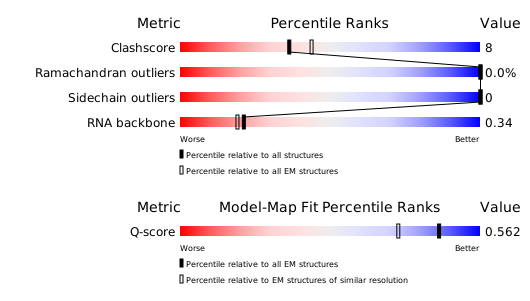
Structure validation
Download full validation report


