






 9NKJ
9NKJ
Structure of substrates-engaged MIDN-bound human 26S proteasome,ED-MIDN state (Composite map)
This is a non-PDB format compatible entry.
Summary for 9NKJ
| Entry DOI | 10.2210/pdb9nkj/pdb |
| EMDB information | 49510 |
| Descriptor | 26S proteasome regulatory subunit 7, 26S proteasome non-ATPase regulatory subunit 6, 26S proteasome non-ATPase regulatory subunit 7, ... (38 entities in total) |
| Functional Keywords | ubiquitin-indepedent, proteasome, midnolin, 26s complex, ed-state, immune system |
| Biological source | Homo sapiens (human) More |
| Total number of polymer chains | 47 |
| Total formula weight | 1670825.69 |
| Authors | Peddada, N.,Beutler, B. (deposition date: 2025-02-28, release date: 2025-05-07, Last modification date: 2025-05-21) |
| Primary citation | Peddada, N.,Zhong, X.,Yin, Y.,Lazaro, D.R.,Wang, J.,Lyon, S.,Choi, J.H.,Bai, X.C.,Moresco, E.M.Y.,Beutler, B. Structural insights into the ubiquitin-independent midnolin-proteasome pathway. Proc.Natl.Acad.Sci.USA, 122:e2505345122-e2505345122, 2025 Cited by PubMed Abstract: The protein midnolin (MIDN) augments proteasome activity in lymphocytes and dramatically facilitates the survival and proliferation of B-lymphoid malignancies. MIDN binds both to proteasomes and to substrates, but the mode of interaction with the proteasome is unknown, and the mechanism by which MIDN facilitates substrate degradation in a ubiquitin-independent manner is incompletely understood. Here, we present cryoelectron microscopy (cryo-EM) structures of the substrate-engaged, MIDN-bound human proteasome in two conformational states. MIDN induces proteasome conformations similarly to ubiquitinated substrates by using its ubiquitin-like domain to bind to the deubiquitinase RPN11 (PSMD14). By simultaneously binding to RPN1 (PSMD2) with its C-terminal α-helix, MIDN positions its substrate-carrying Catch domain above the proteasome ATPase channel through which substrates are translocated before degradation. Our findings suggest that both ubiquitin-like domain and C-terminal α-helix must bind to the proteasome for MIDN to stimulate proteasome activity. PubMed: 40339123DOI: 10.1073/pnas.2505345122 PDB entries with the same primary citation |
| Experimental method | ELECTRON MICROSCOPY (3.84 Å) |
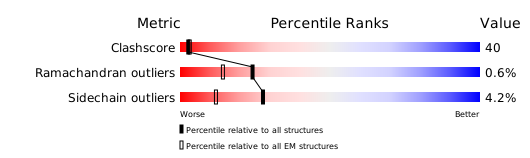
Structure validation
Download full validation report


