






 9MP1
9MP1
Crystal structure of mithramycin analogue MTM SA-7-methyl-Trp in complex with double-stranded DNA AGAGGCCTCT
This is a non-PDB format compatible entry.
Summary for 9MP1
| Entry DOI | 10.2210/pdb9mp1/pdb |
| Related | 9MOZ |
| Descriptor | DNA (5'-D(*AP*GP*AP*GP*GP*CP*CP*TP*CP*T)-3'), methyl (2S)-2-({(2S)-2-[(2R,3S)-3-{[(2S,4R,5R,6R)-4-{[(2S,4R,5S,6R)-4-{[(2S,4S,5R,6R)-4,5-dihydroxy-4,6-dimethyloxan-2-yl]oxy}-5-hydroxy-6-methyloxan-2-yl]oxy}-5-hydroxy-6-methyloxan-2-yl]oxy}-7-{[(2S,4R,5R,6R)-4-{[(2S,4R,5S,6R)-4,5-dihydroxy-6-methyloxan-2-yl]oxy}-5-hydroxy-6-methyloxan-2-yl]oxy}-5,10-dihydroxy-6-methyl-4-oxo-1,2,3,4-tetrahydroanthracen-2-yl]-2-methoxyacetyl}amino)-3-(7-methyl-1H-indol-3-yl)propanoate (non-preferred name), ZINC ION, ... (5 entities in total) |
| Functional Keywords | dna-drug complex, transcription, minor groove, natural product, dna |
| Biological source | synthetic construct |
| Total number of polymer chains | 2 |
| Total formula weight | 9099.50 |
| Authors | Hou, C.,Tsodikov, O.V. (deposition date: 2024-12-29, release date: 2025-04-30, Last modification date: 2025-06-11) |
| Primary citation | Hou, C.,Bhosale, S.,Yasuda, K.,Yetirajam, R.,Leggas, M.,Rohr, J.,Tsodikov, O.V. The Position of Indole Methylation Controls the Structure, DNA Binding, and Cellular Functions of Mithramycin SA-Trp Analogues. Chembiochem, 26:e202401084-e202401084, 2025 Cited by PubMed Abstract: Mithramycin (MTM) is a polyketide anticancer natural product, which functions by noncovalent binding to DNA in the minor groove without intercalation, resulting in inhibiting transcription at G/C-rich promoters. MTM is a potent inhibitor of cancer cells, such as Ewing sarcoma, driven by abnormal fusions involving E26 transformation-specific (ETS) family transcription factors friend leukemia integration 1 (FLI1) and ETS-related gene (ERG). However, MTM is rather toxic and nonselective; therefore, safer, selective analogues of MTM are required for use in the clinic as anticancer drugs. Herein, by using a combination of X-ray crystallographic, biophysical, and cell and molecular biological techniques, the structural and functional consequences of 3-side chain methylation at positions 5, 6, and 7 of the indole ring of the potent analogue MTM SA-Trp are explored. The conformation of the analogues in complexes with DNA, their DNA binding function, cytotoxicity, selectivity, and potency as transcription antagonists depended on the position of the methylation. MTM SA-5-methyl-Trp emerged as the most selective analogue, presumably due to the right balance of the DNA binding and the solvent exposure of the 3-side chain. This study demonstrates that minor chemical changes can have strong effects in analogue development and paves the way to further development of next-generation MTM analogues. PubMed: 40246689DOI: 10.1002/cbic.202401084 PDB entries with the same primary citation |
| Experimental method | X-RAY DIFFRACTION (2.08 Å) |
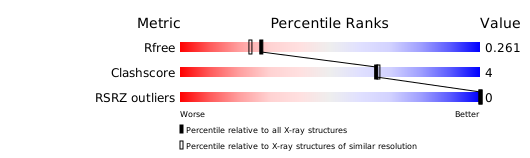
Structure validation
Download full validation report


