






 9MK9
9MK9
Structure of the IFIT2-IFIT3 heterodimer from Mus musculus
Summary for 9MK9
| Entry DOI | 10.2210/pdb9mk9/pdb |
| EMDB information | 48323 |
| Descriptor | Interferon-induced protein with tetratricopeptide repeats 2, Interferon-induced protein with tetratricopeptide repeats 3 (2 entities in total) |
| Functional Keywords | innate immune recognition, interferon-induced proteins, non-self nucleic acids, antiviral protein |
| Biological source | Mus musculus (house mouse) More |
| Total number of polymer chains | 2 |
| Total formula weight | 96442.36 |
| Authors | Glasner, D.R.,Todd, C.,Cook, B.D.,DUrso, A.,Khosla, S.,Estrada, E.,Wagner, J.,Bartels, M.D.,Ford, P.,Prych, J.,Hatch, K.,Yee, B.A.,Ego, K.M.,Liang, Q.,Holland, S.R.,Case, J.B.,Corbett, K.D.,Diamond, M.S.,Yeo, G.W.,Herzik Jr., M.A.,Van Nostrand, E.L.,Daugherty, M.D. (deposition date: 2024-12-16, release date: 2025-03-12) |
| Primary citation | Glasner, D.R.,Todd, C.,Cook, B.,D'Urso, A.,Khosla, S.,Estrada, E.,Wagner, J.D.,Bartels, M.D.,Ford, P.,Prych, J.,Hatch, K.,Yee, B.A.,Ego, K.M.,Liang, Q.,Holland, S.R.,Case, J.B.,Corbett, K.D.,Diamond, M.S.,Yeo, G.W.,Herzik Jr., M.A.,Van Nostrand, E.L.,Daugherty, M.D. Short 5' UTRs serve as a marker for viral mRNA translation inhibition by the IFIT2-IFIT3 antiviral complex. Biorxiv, 2025 Cited by PubMed Abstract: Recognition of "non-self" nucleic acids, including cytoplasmic dsDNA, dsRNA, or mRNAs lacking proper 5' cap structures, is critical for the innate immune response to viruses. Here, we demonstrate that short 5' untranslated regions (UTRs), a characteristic of many viral mRNAs, can also serve as a molecular pattern for innate immune recognition via the interferon-induced proteins IFIT2 and IFIT3. The IFIT2-IFIT3 heterodimer, formed through an intricate domain swap structure resolved by cryo-EM, mediates viral mRNA 5' end recognition, translation inhibition, and ultimately antiviral activity. Critically, 5' UTR lengths <50 nucleotides are necessary and sufficient to sensitize an mRNA to translation inhibition by the IFIT2-IFIT3 complex. Accordingly, diverse viruses whose mRNAs contain short 5' UTRs, such as vesicular stomatitis virus and parainfluenza virus 3, are sensitive to IFIT2-IFIT3-mediated antiviral activity. Our work thus reveals a pattern of antiviral nucleic acid immune recognition that takes advantage of the inherent constraints on viral genome size. PubMed: 39990370DOI: 10.1101/2025.02.11.637299 PDB entries with the same primary citation |
| Experimental method | ELECTRON MICROSCOPY (3.22 Å) |
Structure validation
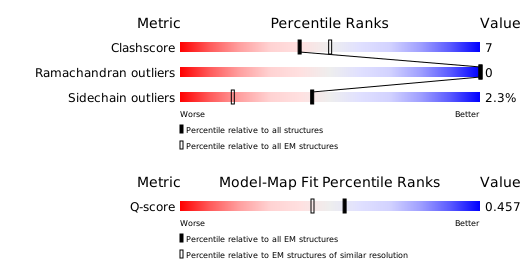
Download full validation report


