






 9MJG
9MJGSummary for 9MJG
| Entry DOI | 10.2210/pdb9mjg/pdb |
| Descriptor | Histone acetyltransferase type B catalytic subunit, (4S,7R)-4-(3-ethoxy-4-hydroxy-5-nitrophenyl)-7-(4-fluorophenyl)-4,6,7,8-tetrahydroquinoline-2,5(1H,3H)-dione (3 entities in total) |
| Functional Keywords | hat1, acetyltransferase, ligand, sgc, transferase |
| Biological source | Homo sapiens (human) |
| Total number of polymer chains | 8 |
| Total formula weight | 306115.30 |
| Authors | Zeng, H.,Li, F.,Wang, X.,Sun, J.,Dong, A.,Peng, H.,Arrowsmith, C.H.,Edwards, A.M.,Halabelian, L.,Structural Genomics Consortium (SGC) (deposition date: 2024-12-15, release date: 2025-02-05, Last modification date: 2026-02-18) |
| Primary citation | Wang, X.,Sun, J.,Ahmad, S.,Yang, D.,Li, F.,Chan, U.H.,Zeng, H.,Simoben, C.V.,Green, S.R.,Silva, M.,Houliston, S.,Dong, A.,Bolotokova, A.,Gibson, E.,Kutera, M.,Ghiabi, P.,Kondratov, I.,Matviyuk, T.,Chuprina, A.,Mavridi, D.,Lenz, C.,Joerger, A.C.,Brown, B.D.,Heath, R.B.,Yue, W.W.,Robbie, L.K.,Beyett, T.S.,Muller, S.,Knapp, S.,Owen, D.R.,Harding, R.,Schapira, M.,Brown, P.J.,Santhakumar, V.,Ackloo, S.,Arrowsmith, C.H.,Edwards, A.M.,Peng, H.,Halabelian, L. Enantioselective protein affinity selection mass spectrometry (E-ASMS). Nat Commun, 17:651-651, 2025 Cited by PubMed Abstract: We report an enantioselective protein affinity selection mass spectrometry screening approach (E-ASMS) that enables the detection of weak binders, informs on selectivity, and generates orthogonal confirmation of binding. After method development with control proteins, we screen 31 human proteins against a designed library of 8,217 chiral compounds. We identify 16 binders to 12 targets, including many proteins predicted to be "challenging to ligand", and confirm their interactions through orthogonal biophysical assays. Seven binders to six targets display enantioselective binding, with K values ranging from 3 to 20 µM. Binders for four targets (DDB1, WDR91, WDR55, and HAT1) are selected for in-depth characterization using X-ray crystallography. In all four cases, the mechanisms underlying enantioselectivity are readily explained. These results demonstrate that E-ASMS enables the identification and characterization of selective and weakly binding ligands for novel protein targets with unprecedented throughput and sensitivity. PubMed: 41407727DOI: 10.1038/s41467-025-67403-2 PDB entries with the same primary citation |
| Experimental method | X-RAY DIFFRACTION (2.58 Å) |
Structure validation
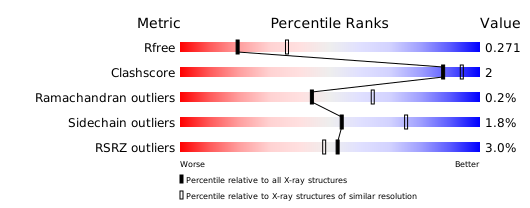
Download full validation report


