






 9M8P
9M8PSummary for 9M8P
| Entry DOI | 10.2210/pdb9m8p/pdb |
| EMDB information | 63717 |
| Descriptor | Soluble cytochrome b562,G-protein coupled receptor 3, (Z)-N-(2-hydroxyethyl)octadec-9-enamide, 1-DODECANOL, ... (5 entities in total) |
| Functional Keywords | gpcr, dimer, antagonist, membrane protein |
| Biological source | Escherichia coli More |
| Total number of polymer chains | 2 |
| Total formula weight | 103589.73 |
| Authors | |
| Primary citation | Chen, G.,Blahova, J.,Staffen, N.,Hubner, H.,Nunhofer, N.,Qiu, C.,Gmeiner, P.,Weikert, D.,Du, Y.,Xu, J. Mechanism and function of GPR3 regulated by a negative allosteric modulator. Nat Commun, 16:7988-7988, 2025 Cited by PubMed Abstract: Allosteric modulators have gained substantial interest in current GPCR drug discovery. Here, we present a mechanism of allosteric modulation involving the dimerization of GPR3, a promising drug target for metabolic diseases and central nervous system disorders. We show that GPR3 forms constitutive homodimers in live cells and reveal that the inhibitor AF64394 functions as a negative allosteric modulator (NAM) specifically targeting dimeric GPR3. Using cryogenic electron microscopy (cryo-EM), we determine the structures of the AF64394-bound GPR3 dimer and its dimer-Gs signaling complex. These high-resolution structures reveal that AF64394 binds to the transmembrane dimer interface. AF64394 binding prevents the dissociation of the GPR3 dimer upon engagement with Gs and restrains transmembrane helix 5 in an inactive-like intermediate conformation, leading to reduced coupling with Gs. Our studies unveil a mechanism of dimer-specific inhibition of signaling with significant implications for the discovery of drugs targeting GPCRs capable of dimerization. PubMed: 40866348DOI: 10.1038/s41467-025-63422-1 PDB entries with the same primary citation |
| Experimental method | ELECTRON MICROSCOPY (3.42 Å) |
Structure validation
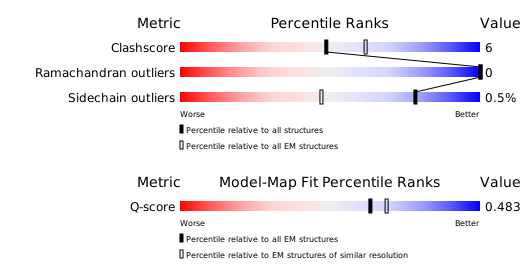
Download full validation report


