






 9LTH
9LTH
Crystal structure of transcriptional regulator (NrpR) from Streptococcus salivarius K12
Summary for 9LTH
| Entry DOI | 10.2210/pdb9lth/pdb |
| Descriptor | Transcriptional regulator (2 entities in total) |
| Functional Keywords | streptococcus salivarius k12, transcriptional regulator, transcription |
| Biological source | Streptococcus salivarius K12 |
| Total number of polymer chains | 1 |
| Total formula weight | 34091.27 |
| Authors | Do, H.,Nguyen, D.l.,Kumaraswami, M. (deposition date: 2025-02-06, release date: 2025-05-21, Last modification date: 2025-07-09) |
| Primary citation | Nguyen, D.L.,Saha, S.,Thacharodi, A.,Singh, B.B.,Mitra, S.,Do, H.,Kumaraswami, M. Environmental pH controls antimicrobial production by human probiotic Streptococcus salivarius. J.Bacteriol., 207:e0005925-e0005925, 2025 Cited by PubMed Abstract: K12 (SAL) is an oral probiotic used to treat or prevent oral infections caused by human pathogens. SAL produces at least three antimicrobials to exert its antimicrobial activity, namely, salivaricin A and salivaricin B, and the newly identified salivabactin. Salivabactin production is catalyzed by a polyketide/non-ribosomal peptide synthase hybrid biosynthetic gene cluster (BGC), termed as . The expression and salivabactin production are transient during SAL growth and , which may negatively impact SAL probiotic efficacy. To understand the molecular basis for transient expression, we assessed the impact of environmental pH on expression. We found that environmental acidification is a critical factor in promoting salivabactin antimicrobial activity and production by inducing expression. We further showed that acidic pH directly influences the quorum-sensing system that controls expression. During environmental acidification, SAL cytosol is acidified, which is sensed by a pH-sensitive histidine switch in the cytosolic transcription regulator, NrpR. The protonation of histidine during cytosolic acidification promotes high-affinity interactions between NrpR and its cognate intercellular signaling peptide, NIP, which leads to upregulation of expression. Collectively, our results indicate that SAL uses a sophisticated regulatory mechanism to orchestrate salivabactin production in an environment that is conducive to its antimicrobial activity. PubMed: 40454994DOI: 10.1128/jb.00059-25 PDB entries with the same primary citation |
| Experimental method | X-RAY DIFFRACTION (2.59 Å) |
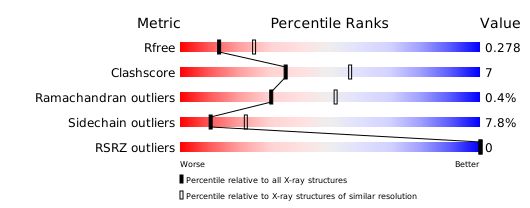
Structure validation
Download full validation report


