






 9LI2
9LI2
DCA-bound state of hPAC structure
Summary for 9LI2
| Entry DOI | 10.2210/pdb9li2/pdb |
| EMDB information | 63110 |
| Descriptor | Proton-activated chloride channel, (3ALPHA,5BETA,12ALPHA)-3,12-DIHYDROXYCHOLAN-24-OIC ACID (2 entities in total) |
| Functional Keywords | hpac, dca, structual protein, membrane protein |
| Biological source | Homo sapiens (human) |
| Total number of polymer chains | 3 |
| Total formula weight | 135223.53 |
| Authors | |
| Primary citation | Zhang, H.,Zhao, Z.,Chen, X.,Ma, Q.,Zhen, W.,Xu, Q.,Wang, Y.,He, B.,Huang, Y.,Xu, P.,Xu, H.,Lu, Z.,Su, N.,Yang, F. Discovery and structural basis of endogenous and exogenous inhibitors of the proton-activated-chloride channel. Cell Rep, 44:115998-115998, 2025 Cited by PubMed Abstract: The proton-activated chloride (PAC) channel is a broadly expressed chloride channel that senses extracellular acidification, regulates endosomal acidification, and participates in many processes, including acid-induced cell death and cancer cell migration. However, the lack of specific modulators has limited our understanding of its function and therapeutic potential. Here, we discovered that endogenous cholesterol (CHL) partially inhibits PAC channel activation. Moreover, we identified a series of CHL analogs and structurally related dyes as full antagonists of the PAC channel, with deoxycholic acid (DCA) and Evans blue (EB) as their representative compounds. By combining cryo-electron microscopy (cryo-EM) and patch-clamp recordings, we revealed the distinct binding and inhibition mechanisms of DCA and EB on this channel. Moreover, in malignant osteosarcoma cells, where PAC channel expression is upregulated, EB inhibited the migration and invasion of these cells. Therefore, we identified DCA and EB as pharmacological tools for the PAC channel, which forms a basis for future drug discovery targeting this channel. PubMed: 40664207DOI: 10.1016/j.celrep.2025.115998 PDB entries with the same primary citation |
| Experimental method | ELECTRON MICROSCOPY (3.72 Å) |
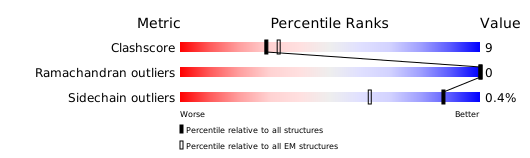
Structure validation
Download full validation report


