






 9LFF
9LFF
Crystal structure of UgpB in complex with G1P
Summary for 9LFF
| Entry DOI | 10.2210/pdb9lff/pdb |
| Descriptor | SN-glycerol-3-phophate ABC transporter, periplasmic SN-glycerol-3-phosphate-binding protein, SN-GLYCEROL-1-PHOSPHATE (3 entities in total) |
| Functional Keywords | g1p/g3p transporter substrate-binding protein, transport protein |
| Biological source | Phaeobacter sp. MED193 |
| Total number of polymer chains | 1 |
| Total formula weight | 49581.79 |
| Authors | |
| Primary citation | Wang, N.,Westermann, L.M.,Li, M.,Li, C.Y.,Murphy, A.R.J.,Gu, Z.,Silvano, E.,Blindauer, C.A.,Lidbury, I.D.E.A.,Zhang, Y.Z.,Scanlan, D.J.,Chen, Y. Structural basis and evolutionary pathways of glycerol-1-phosphate transport in marine bacteria. Proc.Natl.Acad.Sci.USA, 122:e2524546122-e2524546122, 2025 Cited by PubMed Abstract: All cells use lipid membranes to maintain cellular integrity and function, though Archaea utilize lipids composed of glycerol-1-phosphate (G1P), while Bacteria and Eukaryotes use glycerol-3-phosphate (G3P). Given that Archaea contribute significantly to global marine biomass, accounting for 0.3 gigatonnes (Gt) of carbon in the oceans, we aimed to uncover how archaeal G1P is recycled by marine microorganisms. Through a multidisciplinary approach combining microbiology, biochemistry, and structural biology, we identified a G1P transporter in marine bacteria, which we named GpxB. Phylogenetic analysis revealed that GpxB belongs to the organic phosphonate transporter (PhnT) family and is widely distributed in the marine microbiome, found in approximately 5 to 10% of microbial cells in surface marine waters. Strikingly, we also identified a second G1P transporter, UgpB, that is known to transport G3P and belongs to the carbohydrate uptake transporter-1 (CUT1) family, in the model bacterium sp. MED193. To explore the evolutionary pathways that led to the formation of G1P binding sites in both the PhnT and CUT1 families, we determined the structures of GpxB and UgpB bound to G1P and G3P. Using structure-guided mutagenesis and a comparative analysis of the binding pockets within the PhnT and CUT1 families, we traced their evolutionary trajectories, highlighting the distinct strategies through which G1P-binding sites developed in these two protein families. PubMed: 41364767DOI: 10.1073/pnas.2524546122 PDB entries with the same primary citation |
| Experimental method | X-RAY DIFFRACTION (1.5 Å) |
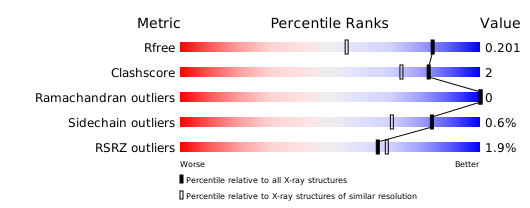
Structure validation
Download full validation report


