






 9KTK
9KTK
Crystal structure of human SIRT3 with its activator SKLB-11A
This is a non-PDB format compatible entry.
Summary for 9KTK
| Entry DOI | 10.2210/pdb9ktk/pdb |
| Descriptor | NAD-dependent protein deacetylase sirtuin-3, mitochondrial, ZINC ION, methyl 2-azanyl-1-[(4-fluorophenyl)methyl]pyrrolo[3,2-b]quinoxaline-3-carboxylate, ... (4 entities in total) |
| Functional Keywords | sirt3 activator cardioprotection, structural protein |
| Biological source | Homo sapiens (human) |
| Total number of polymer chains | 4 |
| Total formula weight | 124933.70 |
| Authors | |
| Primary citation | Zhang, D.,Zhang, J.,Wu, C.,Xiao, Y.,Ji, L.,Hu, J.,Ding, J.,Li, T.,Zhang, Y.,Ouyang, L. Unraveling Small Molecule-Mediated Sirtuin 3 Activation at a Distinct Binding Site for Cardioprotective Therapies. Acs Cent.Sci., 11:704-718, 2025 Cited by PubMed Abstract: Sirtuin 3 (SIRT3), a pivotal mitochondrial deacetylase, plays a critical role in restoring mitochondrial function, particularly through the activation of autophagy. Despite its promise as a cardioprotective target, developing SIRT3 activators and their therapeutic applications remains challenging. Here, we report the identification of , a SIRT3 activator with submicromolar affinity and high efficacy. Structural and mutagenesis analyses revealed a unique allosteric site for in SIRT3, where a conformational change in Leu298 drives its potent activation. Subsequent studies demonstrated that drives autophagy/mitophagy signaling pathways, effectively preventing mitochondrial dysfunction, and improving cardiac dysfunction in both doxorubicin (Dox)-induced cardiotoxicity and myocardial ischemia/reperfusion (I/R) models. Collectively, our data highlight the potential of pharmacological SIRT3 activation as an effective therapeutic strategy for cardioprotection. , as a first-in-class SIRT3 allosteric activator with a distinct binding mode, not only offers a valuable tool for exploring the physiological and pathological roles of SIRT3 deacetylation but also holds promise for the development of targeted cardioprotective therapies. PubMed: 40454347DOI: 10.1021/acscentsci.5c00023 PDB entries with the same primary citation |
| Experimental method | X-RAY DIFFRACTION (2.49 Å) |
Structure validation
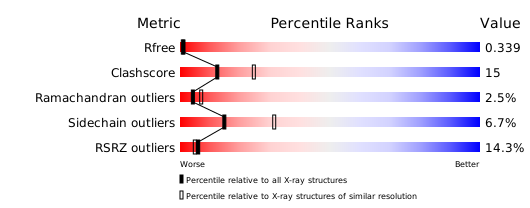
Download full validation report


