






 9KH4
9KH4
Crystal structure of Galectin-8 N-CRD with N-acetyllactosamine
Summary for 9KH4
| Entry DOI | 10.2210/pdb9kh4/pdb |
| Descriptor | Galectin-8, SODIUM ION, ~{N}-[(2~{R},3~{R},4~{R},5~{S},6~{R})-6-(hydroxymethyl)-5-[(2~{S},3~{R},4~{S},5~{R},6~{R})-6-(hydroxymethyl)-3,4,5-tris(oxidanyl)oxan-2-yl]oxy-2,4-bis(oxidanyl)oxan-3-yl]ethanamide, ... (5 entities in total) |
| Functional Keywords | crystal structure of galectin-8 n-crd with n-acetyllactosamine, sugar binding protein |
| Biological source | Homo sapiens (human) |
| Total number of polymer chains | 1 |
| Total formula weight | 17457.59 |
| Authors | |
| Primary citation | Sayed, H.,Mayo, K.H.,Zhou, Y.,Tai, G.,Su, J. Galectin-8 binding to alpha-1 antitrypsin is a physiological mechanism in healthy individuals but exacerbates the symptoms of alpha-1 antitrypsin deficiency. Arch.Biochem.Biophys., 772:110577-110577, 2025 Cited by PubMed Abstract: Alpha-1 Antitrypsin (AAT) is a serine protease inhibitor that protects lung tissue by neutralizing neutrophil elastase. Galectin-8 (Gal-8) is a tandem-repeat galectin with N- and C-terminal carbohydrate recognition domains (CRDs) that bind β-galactoside-containing N-glycans. Both proteins co-localize in pulmonary and circulatory systems, suggesting a physiological interaction. Here, we demonstrate a glycan-dependent binding between Gal-8 and AAT using pull-down assays, mass spectrometry, isothermal titration calorimetry, and size-exclusion chromatography. Importantly, binding of Gal-8 impairs AAT's protease inhibitory activity, with the N-terminal CRD of Gal-8 sufficient to disrupt AAT function. Kinetic analyses show that Gal-8 inhibits AAT and enhances trypsin activity, as evidenced by a decrease in K and an increase in catalytic efficiency (k/K). In cell assays, Gal-8 restored trypsin-mediated proteolysis and induced cell detachment in HeLa and CHO cells despite AAT presence, confirming biological relevance. Leveraging this interaction, we developed a lactose-mediated elution method to purify AAT from human and bovine serum using Gal-8 immobilized on Ni-NTA beads. Moreover, a stable CHO cell line expressing recombinant AAT (∼2 g/L) exhibited glycosylation comparable to serum AAT and retained Gal-8 binding. Our findings reveal Gal-8 as a novel modulator of AAT activity and present a glycan-specific strategy for AAT purification, with implications for biotherapeutic production and quality control. PubMed: 40780418DOI: 10.1016/j.abb.2025.110577 PDB entries with the same primary citation |
| Experimental method | X-RAY DIFFRACTION (1.75 Å) |
Structure validation
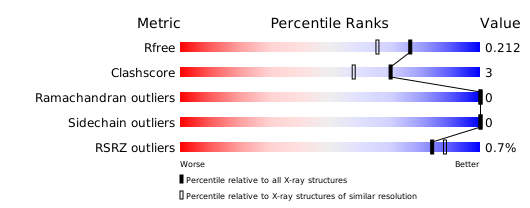
Download full validation report


