






 9K7M
9K7M
Coprinopsis cinerea GH131 protein CcGH131B E161A in complex with cellobiose
Summary for 9K7M
| Entry DOI | 10.2210/pdb9k7m/pdb |
| Related PRD ID | PRD_900023 |
| Descriptor | Glycoside hydrolase 131 catalytic N-terminal domain-containing protein, beta-D-glucopyranose-(1-4)-alpha-D-glucopyranose, 2-(N-MORPHOLINO)-ETHANESULFONIC ACID, ... (6 entities in total) |
| Functional Keywords | coprinopsis cinerea, gh131, cellobiose, cellulose, hydrolase |
| Biological source | Coprinopsis cinerea (strain Okayama-7 / 130 / ATCC MYA-4618 / FGSC 9003) (Inky cap fungus, Hormographiella aspergillata) |
| Total number of polymer chains | 2 |
| Total formula weight | 71654.70 |
| Authors | Shiojima, Y.,Tonozuka, T. (deposition date: 2024-10-24, release date: 2024-11-06, Last modification date: 2025-06-25) |
| Primary citation | Shiojima, Y.,Sano, R.,Kozono, T.,Nishikawa, A.,Kojima, Y.,Yoshida, M.,Sunagawa, N.,Igarashi, K.,Tonozuka, T. Crystal Structure of CcGH131B, a Protein Belonging to Glycoside Hydrolase Family 131 from the Basidiomycete Coprinopsis cinerea . J Appl Glycosci (1999), 72:7202104-7202104, 2025 Cited by PubMed Abstract: Glycoside hydrolase family 131 (GH131) proteins are found in oomycetes, ascomycetes, and basidiomycetes, and have been reported to hydrolyze various β-glucan polysaccharides. , a model basidiomycete, contains two GH131 proteins, CcGH131A and CcGH131B. This study focuses on the structural and functional properties of CcGH131B, a protein that lacks the carbohydrate bonding module 1 (CBM1) domain present in CcGH131A. The crystal structure of CcGH131B was determined. The structure displayed a β-jelly roll fold with extra loops and α-helices, resulting in a deeper substrate-binding groove compared to CcGH131A and also PaGluc131A, a GH131 protein from . A cellobiose-bound structure of the E161A mutant, in which the potential catalytic residue Glu161 was substituted with Ala, showed that the region of the minus subsites bind cellulose. In contrast, the region of the plus subsites mainly consists of hydrophobic amino acid residues and appeared to interact with hydrophobic molecules rather than with carbohydrates. Analysis using native affinity polyacrylamide gel electrophoresis showed that CcGH131B interacted with cellulosic polysaccharides such as methylcellulose and carboxymethylcellulose, while the protein exhibited no detectable enzymatic activity under the tested conditions. These results suggest that the substrate specificity of CcGH131B is likely to be different from those of CcGH131A and PaGluc131A. PubMed: 40502376DOI: 10.5458/jag.7202104 PDB entries with the same primary citation |
| Experimental method | X-RAY DIFFRACTION (1.45 Å) |
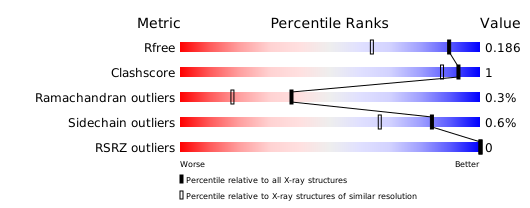
Structure validation
Download full validation report


