






 9JXW
9JXW
Crystal structure of SiRe_0806 from Sulfolobus islandicus
Summary for 9JXW
| Entry DOI | 10.2210/pdb9jxw/pdb |
| Descriptor | PIN domain-containing protein (1 entity in total) |
| Functional Keywords | sulfolobus islandicus, sire_0806, cyclic oligo-adenylates (coas), carf domain, pin domain, rnase, immune system |
| Biological source | Sulfolobus islandicus REY15A |
| Total number of polymer chains | 2 |
| Total formula weight | 99001.23 |
| Authors | |
| Primary citation | Wang, F.,Zhao, P.,Bi, X.,Zheng, R.,Tian, X.,Xu, J.,Jiang, S.,Li, G.,Shen, Y.,She, Q. Cyclic tetraadenylate binding induces dimerization of protein dimers to activate a CRISPR-associated PIN nuclease. Nucleic Acids Res., 53:-, 2025 Cited by PubMed Abstract: Type III CRISPR-Cas systems synthesize cyclic oligoadenylates (cOAs), the second messengers that bind to the CARF (CRISPR-associated Rossman fold) sensor domain and allosterically activate the effector domain of CRISPR ancillary effectors to mediate antiviral defense. An arsenal of such effectors has been identified, but only a minority of them have been characterized thus far. Here, CaPN (a CRISPR-associated PIN domain nuclease), a novel effector protein encoded by Saccharolobus islandicus, was characterized. Biochemical characterization of CaPN revealed that the CARF domain senses cA4 (cyclic tetraadenylate), and its binding to the CARF domain activates the PIN domain for robust RNA cleavage. Genetic assay showed that CaPN mediates growth arrest/cell death to its archaeal host upon cA4 sensing. Determination of the crystal structures of CaPN in apo and in the cA4-bound form revealed that cA4-CARF interactions trigger the conformational changes, leading to the dimerization of the CaPN dimers. These structural changes reposition D296, one of the active site residues in the catalytic pocket, to yield an active PIN domain nuclease. Together, these results unveil a novel molecular mechanism for the activation of cOA-activated Cas ancillary RNases in the CRISPR signaling pathway. PubMed: 40794864DOI: 10.1093/nar/gkaf744 PDB entries with the same primary citation |
| Experimental method | X-RAY DIFFRACTION (3 Å) |
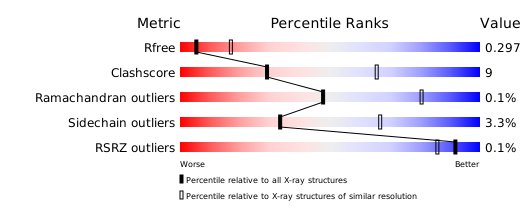
Structure validation
Download full validation report


