






 9JNN
9JNN
Structure of native di-heteromeric GluN1-GluN2B NMDA receptor in rat cortex and hippocampus
Summary for 9JNN
| Entry DOI | 10.2210/pdb9jnn/pdb |
| EMDB information | 38451 61622 |
| Descriptor | Glutamate receptor ionotropic, NMDA 1, (2R)-4-(3-phosphonopropyl)piperazine-2-carboxylic acid, Glutamate receptor ionotropic, NMDA 2B, ... (10 entities in total) |
| Functional Keywords | membrane protein, native nmda receptor, adult rat cartex & hippocampus, glun2a, glun2b, membrane protein-immune system complex, membrane protein/immune system |
| Biological source | Mus musculus More |
| Total number of polymer chains | 12 |
| Total formula weight | 472316.97 |
| Authors | |
| Primary citation | Zhang, M.,Feng, J.,Xie, C.,Song, N.,Jin, C.,Wang, J.,Zhao, Q.,Zhang, L.,Wang, B.,Sun, Y.,Guo, F.,Li, Y.,Zhu, S. Assembly and architecture of endogenous NMDA receptors in adult cerebral cortex and hippocampus. Cell, 188:1198-1207.e13, 2025 Cited by PubMed Abstract: The cerebral cortex and hippocampus are crucial brain regions for learning and memory, which depend on activity-induced synaptic plasticity involving N-methyl-ᴅ-aspartate receptors (NMDARs). However, subunit assembly and molecular architecture of endogenous NMDARs (eNMDARs) in the brain remain elusive. Using conformation- and subunit-dependent antibodies, we purified eNMDARs from adult rat cerebral cortex and hippocampus. Three major subtypes of GluN1-N2A-N2B, GluN1-N2B, and GluN1-N2A eNMDARs were resolved by cryoelectron microscopy (cryo-EM) at the resolution up to 4.2 Å. The particle ratio of these three subtypes was 9:7:4, indicating that about half of GluN2A and GluN2B subunits are incorporated into the tri-heterotetramers. Structural analysis revealed the asymmetric architecture of the GluN1-N2A-N2B receptor throughout the extracellular to the transmembrane layers. Moreover, the conformational variations between GluN1-N2B and GluN1-N2A-N2B receptors revealed the distinct biophysical properties across different eNMDAR subtypes. Our findings imply the structural and functional complexity of eNMDARs and shed light on structure-based therapeutic design targeting these eNMDARs in vivo. PubMed: 39855198DOI: 10.1016/j.cell.2025.01.004 PDB entries with the same primary citation |
| Experimental method | ELECTRON MICROSCOPY (5.4 Å) |
Structure validation
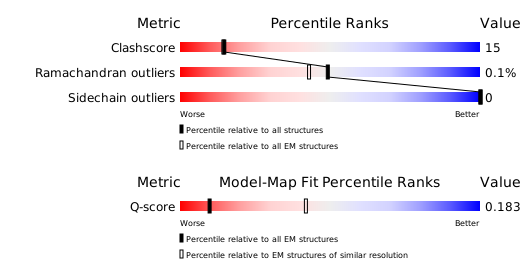
Download full validation report


