






 9JFK
9JFK
Cryo-EM structure of [Pen5]-urotensin (4-11)-bounded human Urotensin receptor (UTS2R)-Gq complex
Summary for 9JFK
| Entry DOI | 10.2210/pdb9jfk/pdb |
| EMDB information | 61433 |
| Descriptor | Guanine nucleotide-binding protein G(I)/G(S)/G(T) subunit beta-1, G subunit q (gi2-mini-gq chimeric), Guanine nucleotide-binding protein G(I)/G(S)/G(O) subunit gamma-2, ... (7 entities in total) |
| Functional Keywords | cryo-em, gpcr, urotensin receptor, uts2r, gq, agonist, [pen5]-urotensin (4-11), complex, signaling protein |
| Biological source | Homo sapiens (human) More |
| Total number of polymer chains | 6 |
| Total formula weight | 127464.73 |
| Authors | |
| Primary citation | Gao, T.,You, C.,Cao, Y.,Xu, X.,Yuan, Q.,Shen, S.,Xu, H.E.,Duan, J. Structural insights into hormone recognition and G-protein coupling of the urotensin-II receptor. J.Biol.Chem., 301:110794-110794, 2025 Cited by PubMed Abstract: Urotensin-II (U-II) is a potent vasoconstrictor peptide that interacts with the human urotensin-II receptor (UTR), a class A G protein-coupled receptor (GPCR) that primarily couples with G proteins. In this study, we present the cryo-electron microscopy structure of the miniG-coupled UTR bound to the potent UTR agonist P5U, providing insights into unique ligand recognition and activation mechanisms. Unlike typical linear peptides, the cyclic structure of P5U engages the receptor's transmembrane domains through key side chain interactions involving residues F6, W7, K8, and Y9, which are crucial for receptor activation. Comparative analysis with somatostatin receptors (SSTRs) reveals distinct ligand specificity, driven by variations in side chain composition. Notably, we identify F274 as the toggle switch residue in UTR, in contrast to the classical W seen in other GPCRs. Our findings elucidate the structural basis for UTR's G coupling specificity, highlighting unique Gα interactions. This study advances the understanding of U-II signaling and offers a foundation for developing selective UTR modulators, with potential therapeutic implications for cardiovascular diseases linked to dysregulated U-II activity. PubMed: 41062066DOI: 10.1016/j.jbc.2025.110794 PDB entries with the same primary citation |
| Experimental method | ELECTRON MICROSCOPY (3.23 Å) |
Structure validation
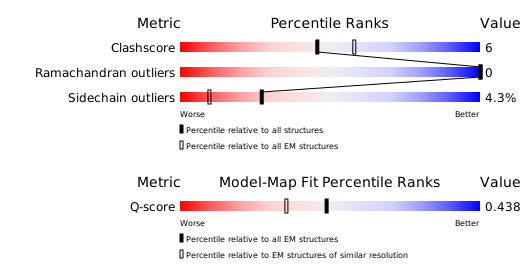
Download full validation report


