






 9J6E
9J6E
Crystal structure of BioZ from Agrobacterium tumefaciens in complex with galutaryl-CoA
This is a non-PDB format compatible entry.
Summary for 9J6E
| Entry DOI | 10.2210/pdb9j6e/pdb |
| Descriptor | 3-oxopimeloyl-[acyl-carrier-protein] synthase, COENZYME A (3 entities in total) |
| Functional Keywords | biotin synthesis, biosynthetic protein |
| Biological source | Agrobacterium fabrum (strain C58 / ATCC 33970) (Agrobacterium tumefaciens (strain C58)) |
| Total number of polymer chains | 4 |
| Total formula weight | 140205.95 |
| Authors | |
| Primary citation | Hang, X.,Zhang, L.,Huang, Y.,Hu, Y.,Zeng, Q.,Cronan, J.E.,Zhang, L.,Bi, H. Switching the strict substrate specificities of the beta-ketoacyl-acyl carrier protein synthases, FabH and BioZ. Proc.Natl.Acad.Sci.USA, 122:e2509301122-e2509301122, 2025 Cited by PubMed Abstract: The β-ketoacyl-acyl carrier protein (ACP) synthases are pivotal elongation enzymes that catalyze the condensation of acyl-CoA or acyl-ACP with malonyl-ACP to produce β-ketoacyl-ACP. Among these, the homologous enzymes FabH (β-ketoacyl-ACP synthase III) and the recently characterized BioZ play crucial roles, initiating the biosynthetic pathways for fatty acids and biotin, respectively. FabH primarily utilizes acetyl-CoA as the primer substrate, whereas BioZ exclusively condenses the longer glutaryl-CoA, which contains a charged ω-carboxyl group. Despite their similar catalytic mechanisms, the molecular bases for the strict substrate specificities remain undetermined. Here, we report crystal structures of the BioZ: glutaryl-CoA cocrystalized complexes and demonstrate the ability to swap the physiological functions and substrate specificities between FabH and BioZ. This functional interchange was achieved by grafting the β8-α9 loop plus residue Ala317 of BioZ to FabH, resulting in a shift in substrate preference from acetyl-CoA to glutaryl-CoA. The reverse manipulations of BioZ resulted in FabH activity. These data identify the structural elements as the minimal determinants of substrate specificity and enzyme function. These findings provide valuable insights into the molecular mechanisms of substrate recognition and catalysis by FabH and BioZ and offer a foundation for the development of targeted therapeutic strategies against these enzymes. PubMed: 41183203DOI: 10.1073/pnas.2509301122 PDB entries with the same primary citation |
| Experimental method | X-RAY DIFFRACTION (2.15 Å) |
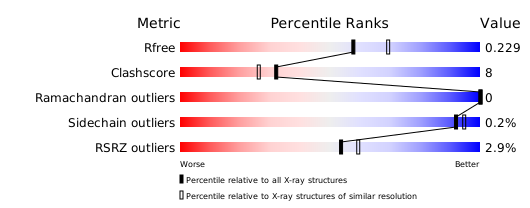
Structure validation
Download full validation report


