






 9IPT
9IPT
Crystal structure of a TetR family regulator AmvR from Acinetobacter baumannii with spermidine bound
Summary for 9IPT
| Entry DOI | 10.2210/pdb9ipt/pdb |
| Descriptor | TetR family transcriptional regulator, SPERMIDINE (2 entities in total) |
| Functional Keywords | tetr family regulator, effector-binding domain, transcription |
| Biological source | Acinetobacter baumannii |
| Total number of polymer chains | 2 |
| Total formula weight | 44583.04 |
| Authors | |
| Primary citation | Wang, N.,Wang, X.,Zhou, M.,Lu, Q.,Xu, Y.,Wang, Y.,Wang, H.,Yang, B.,He, S.,Xu, L.,Li, J.,Ge, H.,Ma, J. Structural basis for spermidine recognition and modulation of Acinetobacter baumannii multidrug efflux regulator AmvR. Mbio, 16:e0008125-e0008125, 2025 Cited by PubMed Abstract: is a gram-negative, opportunistic pathogen frequently associated with hospital-acquired infections. Due to its resistance to multiple antibiotics, it is emerging as a major nosocomial pathogen, causing a wide range of severe infections such as pneumonia, meningitis, and bloodstream infections. In many cases, the intrinsic activities of efflux pumps contribute to the development of drug resistance. The polyamine-binding protein AmvR regulates the multidrug efflux pump AmvA, which is pivotal for transporting polyamines, an abundant and prevalent class of amino acid-derived metabolites. Here, we report the crystal structure of the AmvR protein bound to its physiological substrate, spermidine, thereby offering structural and functional insights into AmvR. By employing electrophoretic mobility shift assays and DNase I footprinting, we identified the recognition sites of the intragenic regions of and by AmvR. Moreover, a fluorescence reporter assay revealed that AmvR repressed the expressions of AmvA and AmvR. In addition, isothermal titration calorimetry indicated that spermidine may be a natural ligand of AmvR. Collectively, these experiments provided a better understanding of substrate recognition for the discovery of potential inhibitors. Furthermore, our results revealed that substrate binding triggers a localized conformational change in the AmvR protein, as supported by size-exclusion chromatography and static light scattering, suggesting a distinctive regulatory mechanism within the TetR family transcription factors. PubMed: 40162807DOI: 10.1128/mbio.00081-25 PDB entries with the same primary citation |
| Experimental method | X-RAY DIFFRACTION (2.5 Å) |
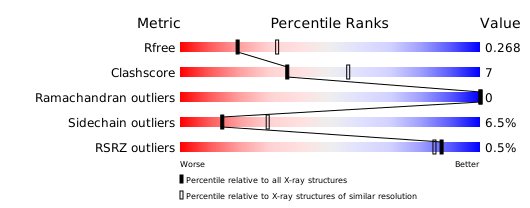
Structure validation
Download full validation report


