






 9I3F
9I3F
Crystal structure of the AGR2 and IRE1beta_loop complex
Summary for 9I3F
| Entry DOI | 10.2210/pdb9i3f/pdb |
| Descriptor | Serine/threonine-protein kinase/endoribonuclease IRE2, Anterior gradient protein 2 homolog, MAGNESIUM ION, ... (4 entities in total) |
| Functional Keywords | molecular chaperones, unfolded protein response (upr), endoplasmic reticulum (er), protein multimerisation, chaperone |
| Biological source | Homo sapiens (human) More |
| Total number of polymer chains | 8 |
| Total formula weight | 82818.80 |
| Authors | |
| Primary citation | Neidhardt, L.,Tung, J.,Kuchersky, M.,Milczarek, J.,Kargas, V.,Stott, K.,Rosenzweig, R.,Ron, D.,Yan, Y. A structural basis for chaperone repression of stress signaling from the endoplasmic reticulum. Mol.Cell, 85:4047-, 2025 Cited by PubMed Abstract: The endoplasmic reticulum (ER) unfolded protein response (UPR) is tuned by the balance between unfolded proteins and chaperones. Reserve chaperones suppress UPR transducers via their stress-sensing luminal domains, but the underlying mechanisms remain unclear. The ER chaperone AGR2 is known to repress the UPR transducer IRE1β. Here, structural prediction, X-ray crystallography, and NMR spectroscopy identify critical interactions between an AGR2 monomer and a regulatory loop in IRE1β's luminal domain. However, in the repressive complex, it is an AGR2 dimer that binds IRE1β. Cryoelectron microscopy (cryo-EM) reconstruction explains this feature: one AGR2 protomer engages the regulatory loop, while the second asymmetrically binds IRE1β's luminal domain's C terminus, blocking IRE1β-activating dimerization. Molecular dynamic simulations indicate that the second, disruptive AGR2 protomer exploits rare fluctuations in the IRE1β dimer that expose its binding site. Thus, AGR2 disrupts IRE1β dimers to suppress the UPR, priming the system for activation by chaperone clients that compete for AGR2. PubMed: 41135511DOI: 10.1016/j.molcel.2025.09.032 PDB entries with the same primary citation |
| Experimental method | X-RAY DIFFRACTION (1.9 Å) |
Structure validation
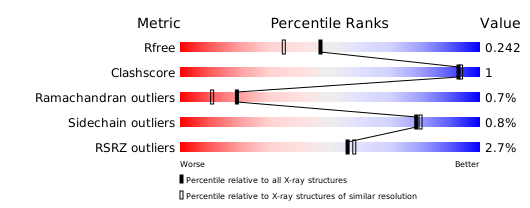
Download full validation report


