






 9HNW
9HNW
USP1-UAF1 bound to Lys63-linked diubiquitin
Summary for 9HNW
| Entry DOI | 10.2210/pdb9hnw/pdb |
| EMDB information | 52316 |
| Descriptor | Ubiquitin carboxyl-terminal hydrolase 1, WD repeat-containing protein 48, Polyubiquitin-B, ... (5 entities in total) |
| Functional Keywords | usp1, deubiquitinating enzyme, cysteine protease, complex, hydrolase |
| Biological source | Homo sapiens (human) More |
| Total number of polymer chains | 4 |
| Total formula weight | 189134.77 |
| Authors | Keijzer, N.,Sakoltchik, J.,Sixma, T.K. (deposition date: 2024-12-11, release date: 2025-02-12, Last modification date: 2025-08-20) |
| Primary citation | Keijzer, N.,Sakoltchik, J.,Majumder, K.,van Lil, N.,El Oualid, F.,Fish, A.,Sixma, T.K. USP1/UAF1 targets polyubiquitinated PCNA with an exo-cleavage mechanism that can temporarily enrich for monoubiquitinated PCNA. Nat Commun, 16:6991-6991, 2025 Cited by PubMed Abstract: DNA damage tolerance (DDT) is an important pathway that allows cells to bypass DNA lesions during replication. DDT is orchestrated by ubiquitination of PCNA, where monoubiquitinated PCNA (PCNA-Ub) initiates recruitment of TLS polymerases but also serves as a substrate for further ubiquitination, forming K63-polyubiquitinated PCNA that leads to HR-mediated bypass mechanisms. Recent work on USP1/UAF1 inhibition revealed that formation of K48-linked chains also occurs on PCNA, resulting in its proteasomal degradation. USP1/UAF1 is established as deubiquitinating enzyme (DUB) for PCNA-Ub, but little is known about removal of ubiquitin chains on PCNA. Here we show that USP1/UAF1 cleaves both K48 and K63-linked ubiquitin chains on PCNA efficiently, using an exo-cleavage mechanism. Kinetic analysis reveals that USP1/UAF1 prefers cleaving the ubiquitin-ubiquitin bond over cleavage of the ubiquitin-PCNA bond and therefore treats poly- and monoubiquitinated PCNA as different substrates. A cryo-EM structure of USP1/UAF1 with a K63-diubiquitin and structure-based mutagenesis suggests that this mechanistic preference is maintained in evolution. This unusual mechanism can cause temporal enrichment of monoubiquitinated PCNA during polyubiquitination. It will be interesting to see how this affects DDT pathway balance. PubMed: 40739138DOI: 10.1038/s41467-025-61768-0 PDB entries with the same primary citation |
| Experimental method | ELECTRON MICROSCOPY (3.04 Å) |
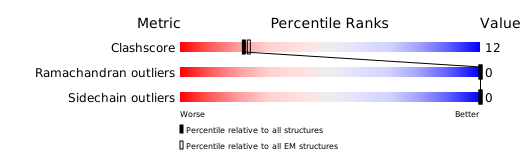
Structure validation
Download full validation report


