






 9HM2
9HM2
A swapped dimeric form of ZO1/TJP1 PDZ2 in complex with the C-terminal peptide from protein E of SARS-CoV-2
Summary for 9HM2
| Entry DOI | 10.2210/pdb9hm2/pdb |
| Descriptor | Tight junction protein ZO-1, Envelope small membrane protein, IODIDE ION, ... (4 entities in total) |
| Functional Keywords | pdz2, scaffolding, cell adhesion, tight junction |
| Biological source | Homo sapiens (human) More |
| Total number of polymer chains | 4 |
| Total formula weight | 21986.85 |
| Authors | Alvarez, F.,Mechaly, A.,Haouz, A.,Caillet-Saguy, C. (deposition date: 2024-12-06, release date: 2025-10-22, Last modification date: 2026-01-28) |
| Primary citation | Alvarez, F.,Larrous, F.,Mechaly, A.,Bardiaux, B.,Goor, Q.,Haouz, A.,Seon-Meniel, B.,de Sousa, R.A.,Bourg, S.,Desmaele, D.,Figadere, B.,Wolff, N.,Munier-Lehmann, H.,Caillet-Saguy, C. HTRF-based identification of small molecules targeting SARS-CoV-2 E protein interaction with ZO-1 PDZ2. Sci Rep, 16:2034-2034, 2025 Cited by PubMed Abstract: The SARS-CoV-2 E protein through its C-terminal PDZ-binding motif (PBM) interacts with several host PDZ-containing proteins, including Zonula occludens-1 (ZO-1) protein via its PDZ2 domain, thereby contributing to viral pathogenesis. Targeting this interaction represents a potential therapeutic strategy. In this study, we determined the X-ray structure of the E PBM peptide in complex with the ZO-1 PDZ2 domain at 1.7 Å resolution. The structure revealed a domain-swapped dimer conformation of ZO-1 PDZ2, with the E PBM peptide conventionally bound within the PDZ domain's canonical binding groove, exhibiting key interactions characteristic of type II PBM/PDZ interactions. To identify potential inhibitors of the E PBM/ZO-1 PDZ2 interaction, we performed a Homogeneous Time-Resolved Fluorescence (HTRF) screening using a protein-protein interaction-focused library of 1000 compounds. This led to the identification of 36 hits that disrupted this interaction. Subsequent cytotoxicity and dose-response assays narrowed the selection to 14 promising compounds. Docking simulations showed that some compounds bind within or near the PBM-binding pocket, supporting a competitive mechanism of interaction inhibition, while others bind at a central interface between the two PDZ monomers, suggesting an inhibition of dimerization, which in turn prevents PBM binding. Thus, the E PBM/ZO-1 PDZ2 interaction can be inhibited through both direct and indirect mechanisms. Finally, antiviral assays using a NanoLuciferase-expressing recombinant SARS-CoV-2 demonstrated that one compound, C19, significantly reduced viral replication, highlighting its potential as a candidate for further therapeutic development. PubMed: 41457070DOI: 10.1038/s41598-025-31755-y PDB entries with the same primary citation |
| Experimental method | X-RAY DIFFRACTION (1.72 Å) |
Structure validation
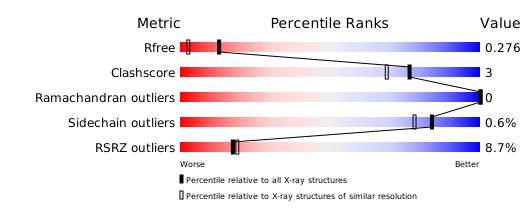
Download full validation report


