






 9H2D
9H2D
Human IFT172 C-terminal U-box domain crystal structure
Summary for 9H2D
| Entry DOI | 10.2210/pdb9h2d/pdb |
| Descriptor | Intraflagellar transport protein 172 homolog, 4-(2-HYDROXYETHYL)-1-PIPERAZINE ETHANESULFONIC ACID, CHLORIDE ION, ... (4 entities in total) |
| Functional Keywords | cilia, intraflagellar transport, ift172, intracellular trafficking, u-box, ubiquitin, protein transport |
| Biological source | Homo sapiens (human) |
| Total number of polymer chains | 2 |
| Total formula weight | 61551.36 |
| Authors | Lorentzen, E.,Zacharia, N.K.,Bhogaraju, S. (deposition date: 2024-10-11, release date: 2024-12-04, Last modification date: 2026-07-08) |
| Primary citation | Zacharia, N.K.,Kuhns, S.,Boegholm, N.,Christensen, A.,Wang, J.,Petriman, N.A.,Lorentzen, A.,Fialova, J.L.,Menguy, L.,Saunier, S.,Christensen, S.T.,Andersen, J.S.,Bhogaraju, S.,Lorentzen, E. Intraflagellar transport protein IFT172 contains a C-terminal ubiquitin-binding U-box-like domain involved in ciliary signaling. Elife, 14:-, 2026 Cited by PubMed Abstract: Intraflagellar transport (IFT) is a fundamental process driving ciliogenesis in most eukaryotic organisms. IFT172, the largest protein of the IFT complex, plays a crucial role in cilium formation, and several disease-causing IFT172 variants have been identified in ciliopathy patients. While IFT172 is tethered to the IFT-B complex via its N-terminal domains, the function of its C-terminal domains has remained elusive. Here, using both human and IFT172, we reveal that the C-terminal part of IFT172 interacts with IFT-A complex subunits, providing a molecular basis for the role of IFT172 in bridging IFT-A and IFT-B complexes. We determine the crystal structure of the C-terminal part of IFT172, uncovering a conserved U-box-like domain often found in E3 ubiquitin ligases. This domain exhibits ubiquitin-binding properties, and IFT172 undergoes ubiquitin conjugation in vitro, an activity that is reduced in the C1727R patient ciliopathy variant. We use CRISPR-engineered RPE-1 cells to demonstrate that the U-box-like domain is essential for IFT172 protein stability and proper cilium formation. Notably, RPE-1 cells with heterozygous deletion of the U-box domain show altered TGF-β signaling responses, particularly in SMAD2 phosphorylation levels and AKT activation. Our findings suggest that IFT172, beyond its structural role in bridging IFT-A and IFT-B complexes within IFT trains, harbors a conserved U-box-like domain with potential involvement in ciliary ubiquitination processes and signaling, providing new insights into the molecular mechanisms underlying IFT172-related ciliopathies. PubMed: 42334455DOI: 10.7554/eLife.104906 PDB entries with the same primary citation |
| Experimental method | X-RAY DIFFRACTION (2.097 Å) |
Structure validation
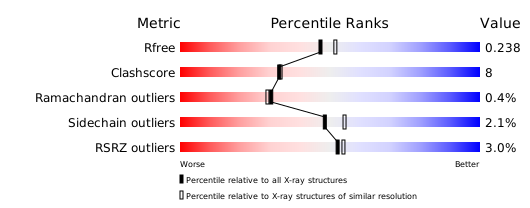
Download full validation report


