






 9GNK
9GNK
Nitratidesulfovibrio vulgaris [FeFe]-hydrogenase variant with both subunits linked by a 13 amino acid linker peptide derived from CpI of Clostridium pasteurianum
Replaces: 8RU7Summary for 9GNK
| Entry DOI | 10.2210/pdb9gnk/pdb |
| Descriptor | Periplasmic [Fe] hydrogenase large subunit,Periplasmic [Fe] hydrogenase small subunit, CARBON MONOXIDE, dicarbonyl[bis(cyanide-kappaC)]-mu-(iminodimethanethiolatato-1kappaS:2kappaS)-mu-(oxomethylidene)diiron(2+), ... (8 entities in total) |
| Functional Keywords | [fefe] hydrogenase, iron-sulfur cluster, metalloenzyme, hydrogen production, fusion protein, oxidoreductase |
| Biological source | Nitratidesulfovibrio vulgaris More |
| Total number of polymer chains | 1 |
| Total formula weight | 56889.41 |
| Authors | Bikbaev, K.,Jaenecke, J.,Winkler, M.,Span, I. (deposition date: 2024-09-03, release date: 2025-09-24, Last modification date: 2026-09-02) |
| Primary citation | Jaenecke, J.,Bikbaev, K.,Malagnini, M.,Bronold, J.,Yadav, S.,Apfel, U.P.,Leger, C.,Birrell, J.A.,Span, I.,Plumere, N.,Winkler, M. Subunit fusion unlocks rapid in vitro maturation for slowly activating heterodimeric [FeFe]-hydrogenases. Chem Sci, 17:7678-7689, 2026 Cited by PubMed Abstract: Hydrogenases offer a sustainable alternative to noble metals for catalyzing H-oxidation and H-production. The heterodimeric [FeFe]-hydrogenase of ATCC 7757 (HydAB) is most promising due to its exceptional catalytic activity and high-yield heterologous expression of its apo-form. Scalable production of the holo-form relies on maturation of the apo-enzyme using a chemically synthesized 2Fe cofactor mimic. However, the unusually slow maturation of HydAB raises mechanistic questions and limits its scalability. Through structural and sequence analysis, we identified the cause of this slow maturation and redesigned the enzyme subunit fusion, inserting short peptide linkers near the active site. This modification facilitates the rearrangement of a critical locking element after cofactor uptake, increasing the maturation rate by up to 41-fold without compromising catalytic performance. Our findings elucidate a key step in the plug-lock-lid mechanism underlying maturation and promote the industrial applicability of HydAB. PubMed: 41756151DOI: 10.1039/d5sc07299a PDB entries with the same primary citation |
| Experimental method | X-RAY DIFFRACTION (1.05 Å) |
Structure validation
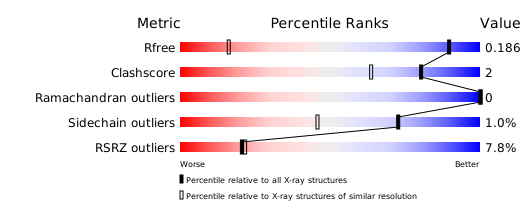
Download full validation report


