






 9GI4
9GI4
TFIIIC5 DNA binding domain
Summary for 9GI4
| Entry DOI | 10.2210/pdb9gi4/pdb |
| Descriptor | General transcription factor 3C polypeptide 5, PHOSPHATE ION (3 entities in total) |
| Functional Keywords | tfiiic, transcription, pol iii, dna binding protein |
| Biological source | Homo sapiens (human) |
| Total number of polymer chains | 6 |
| Total formula weight | 168702.55 |
| Authors | Leen, E.,Bayliss, R. (deposition date: 2024-08-16, release date: 2025-08-27, Last modification date: 2026-09-16) |
| Primary citation | Leen, E.,Yeoh, S.,Sahak, E.,Mitchell, E.,Wildsmith, G.,Batchelor, M.,Calabrese, A.N.,Buchel, G.,Bayliss, R. Mechanism of interaction between the transactivation domain of N-myc and the DNA-binding surface of TFIIIC5. Nucleic Acids Res., 54:-, 2026 Cited by PubMed Abstract: N-myc is a transcription factor, a powerful driver of cellular growth and an important oncoprotein. N-myc interacts with many factors, including the RNA Polymerase III assembly factor, TFIIIC, a six-subunit complex that is essential for the transcription of small, structured RNA. TFIIIC and N-myc mutually restrict each other's chromatin association, and their complex contributes to quality control in mRNA transcription. We previously demonstrated that the intrinsically disordered transactivation domain of N-myc interacts directly with a sub-complex of TFIIIC, τA. Structural studies by others show that DNA binding of τA is largely mediated by TFIIIC3, leaving open the role of the DNA-binding domain of TFIIIC5. Here, we demonstrate that this domain is a binding site for two regions in the transactivation domain of N-myc, through an integrated approach combining NMR spectroscopy, hydrogen-deuterium exchange mass spectrometry, and interaction assays (pull-downs, ITC, fluorescence polarization, and co-immunoprecipitation). AlphaFold modelling predicts with high-confidence a binding mode for the higher affinity N-myc motif that overlaps with the predicted intramolecular binding site of the C-terminal acidic plug of TFIIIC5, removal of which enhances the binding of N-myc. This model elucidates how the N-myc:TFIIIC5 interaction competes with DNA and other interactions, providing a basis for their mutual regulation. PubMed: 41755638DOI: 10.1093/nar/gkag181 PDB entries with the same primary citation |
| Experimental method | X-RAY DIFFRACTION (2.63 Å) |
Structure validation
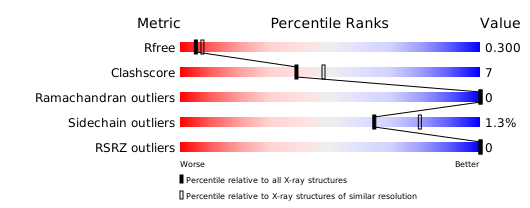
Download full validation report


