






 9GG5
9GG5
Cryo-EM structure of Thromboxane A2 receptor-miniGq protein complex bound to U46619
Summary for 9GG5
| Entry DOI | 10.2210/pdb9gg5/pdb |
| EMDB information | 51324 |
| Descriptor | Thromboxane A2 receptor, Engineered miniGq, Guanine nucleotide-binding protein G(I)/G(S)/G(T) subunit beta-1, ... (6 entities in total) |
| Functional Keywords | single particle cryo-em, gpcr, g-proteins, membrane protein |
| Biological source | Homo sapiens (human) More |
| Total number of polymer chains | 4 |
| Total formula weight | 112722.98 |
| Authors | Matzov, D.,Krawinski, P.,Caffrey, M.,Shalev Benami, M. (deposition date: 2024-08-13, release date: 2025-08-27, Last modification date: 2026-04-15) |
| Primary citation | Krawinski, P.,Matzov, D.,Ryder, A.,Lal, K.,Karlov, D.S.,Chalhoub, G.,Mulvaney, E.P.,Kinsella, B.T.,McCormick, P.J.,Caffrey, M.,Tikhonova, I.G.,Shalev-Benami, M. Structural and dynamic insights into agonist recognition and function of the thromboxane A 2 receptor. Nat Commun, 17:-, 2026 Cited by PubMed Abstract: The thromboxane A receptor (TP), expressed in platelets and smooth muscle, plays an important role in blood clotting and muscle contraction. The endogenous ligand of this G protein-coupled receptor (GPCR), thromboxane A (TXA), is a short-lived arachidonic acid metabolite with a half-life of ∼30 seconds, which makes investigating the TP structure and activation mechanism highly challenging. Here we determine the structures of the TP in complex with the synthetic agonists, U46619 and I-BOP, stable analogues of the natural ligand, in the presence of the signalling protein partner, G. The structures reveal a unique activation switch for the receptor that differs from typical class A GPCR family members. Complemented by functional studies, mutational analysis, docking, and molecular dynamics (MD) simulations, our investigation highlights the differences between agonist and antagonist binding and explores the ligand entry mechanism to the binding pocket from within the membrane via a molecular gate composed of two transmembrane helices. In addition, our study provides crucial information to aid in the rational design of compounds targeting the TP, and offers mechanistic insights into inherited disorders associated with mutations in the TP. PubMed: 41730883DOI: 10.1038/s41467-026-69844-9 PDB entries with the same primary citation |
| Experimental method | ELECTRON MICROSCOPY (3.26 Å) |
Structure validation
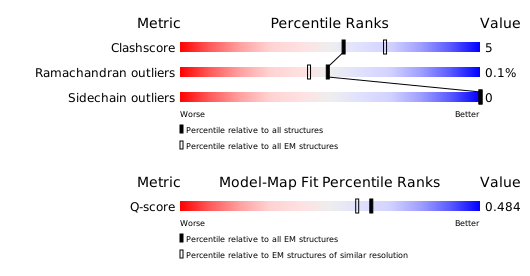
Download full validation report


