






 9GFE
9GFE
hRAR LBD protein in complex with AM580 agonist ligand and a stapled peptide
Summary for 9GFE
| Entry DOI | 10.2210/pdb9gfe/pdb |
| Descriptor | Retinoic acid receptor alpha, Stapled peptide-like ligand, 4-{[(5,5,8,8-tetramethyl-5,6,7,8-tetrahydronaphthalen-2-yl)carbonyl]amino}benzoic acid, ... (4 entities in total) |
| Functional Keywords | hrar lbd protein, complex, stapled peptide, transcription |
| Biological source | Homo sapiens (human) More |
| Total number of polymer chains | 2 |
| Total formula weight | 28136.95 |
| Authors | Perdriau, C.,Luton, A.,Zimmeter, K.,Neuville, M.,Saragaglia, C.,Peluso-lltis, C.,Kauffmann, B.,Collie, G.,Rochel, N.,Guichard, G.,Pasco, M. (deposition date: 2024-08-09, release date: 2025-01-22, Last modification date: 2025-02-05) |
| Primary citation | Perdriau, C.,Luton, A.,Zimmeter, K.,Neuville, M.,Saragaglia, C.,Peluso-Iltis, C.,Osz, J.,Kauffmann, B.,Collie, G.W.,Rochel, N.,Guichard, G.,Pasco, M. Guanidinium-Stapled Helical Peptides for Targeting Protein-Protein Interactions. Angew.Chem.Int.Ed.Engl., 64:e202416348-e202416348, 2025 Cited by PubMed Abstract: Peptide stapling has emerged as a versatile approach in drug discovery to reinforce secondary structure elements especially α-helices and improve properties of linear bioactive peptides. Inspired by the prevalence of arginine in protein-protein and protein-DNA interfaces, we investigated guanidinium-stapling as a means to constrain helical peptides. Guanidinium stapling was readily achieved on solid support, utilizing two orthogonally protected lysine or unatural α-amino acid residues with an amino function. This method allows for easy modulation of the nature and size of the staple as well as helix propensity. Evaluating a set of guanidinium-stapled peptides for their interaction with different protein targets identified several binders with increased target affinity. X-ray structure determination of four complexes revealed that all stapled peptides adopt a helical conformation upon protein binding. Notably, the disubstituted guanidinium generally exhibits a distinct cis/trans conformation and, in one instance, retains a conserved hydrogen bond with the protein surface. By identifying, for the first time, the guanidinium moiety as an effective helical peptide stapling group, this research significantly expands the repertoire of α-helix stapling techniques for the creation of useful protein mimics. PubMed: 39714600DOI: 10.1002/anie.202416348 PDB entries with the same primary citation |
| Experimental method | X-RAY DIFFRACTION (1.583 Å) |
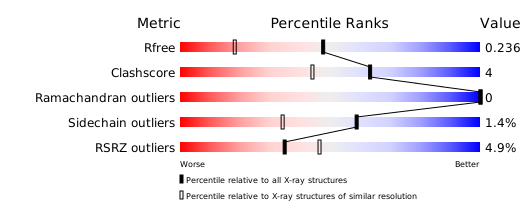
Structure validation
Download full validation report


