






 9G3T
9G3T
Structure of the PRO-PRO endopeptidase (PPEP-3) E153A Y189F from Geobacillus thermodenitrificans
Summary for 9G3T
| Entry DOI | 10.2210/pdb9g3t/pdb |
| Related | 9G0J |
| Descriptor | ATLF-like domain-containing protein, ZINC ION, BICINE, ... (6 entities in total) |
| Functional Keywords | endopeptidase, metalloprotease, zinc, hydrolase |
| Biological source | Geobacillus thermodenitrificans NG80-2 |
| Total number of polymer chains | 2 |
| Total formula weight | 53584.70 |
| Authors | Claushuis, B.,Wojtalla, F.,van Leeuwen, H.,Corver, J.,Baumann, U.,Hensbergen, P. (deposition date: 2024-07-12, release date: 2025-07-23, Last modification date: 2026-02-18) |
| Primary citation | Claushuis, B.,Wojtalla, F.,Papenhagen, L.,Cordfunke, R.A.,de Ru, A.H.,van Leeuwen, H.C.,Corver, J.,Hensbergen, P.J.,Baumann, U. Structural analyses and substrate profiling of PPEP-3 provide new insights into the molecular basis of Pro-Pro endopeptidase specificity. Iscience, 29:114360-114360, 2026 Cited by PubMed Abstract: Pro-Pro endopeptidases (PPEPs) are secreted bacterial enzymes that uniquely cleave peptide bonds between adjacent proline residues. Their active site accommodates six substrate residues (P3 to P3'), with interactions at these positions determining specificity. In this study, we investigated the substrate specificity of PPEP-3 from using synthetic peptide libraries and liquid chromatography-tandem mass spectrometry (LC-MS/MS). We also determined the atomic structures of PPEP-3 in unbound and substrate-bound forms. By correlating substrate profiling with structural data, we identified key mechanisms influencing PPEP-3 specificity. This integrated analysis reveals stark differences in specificity for the P2 and P2' positions compared to other PPEPs, most notably Tyr161 and Phe191, which shape the substrate-binding cleft and influence the accommodation of side chains at these positions. Combining comprehensive substrate profiling with structural analyses offers a powerful approach to uncover the molecular basis of protease function. PubMed: 41583563DOI: 10.1016/j.isci.2025.114360 PDB entries with the same primary citation |
| Experimental method | X-RAY DIFFRACTION (1.6 Å) |
Structure validation
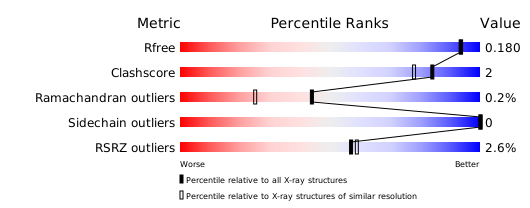
Download full validation report


