






 9FKR
9FKR
KAT6A IN COMPLEX WITH SMALL MOLECULE INHIBITOR BAY-184
This is a non-PDB format compatible entry.
Summary for 9FKR
| Entry DOI | 10.2210/pdb9fkr/pdb |
| Descriptor | Histone acetyltransferase KAT6A, ZINC ION, 6-(dimethylamino)-~{N}-(2-phenylphenyl)sulfonyl-1-benzofuran-2-carboxamide, ... (5 entities in total) |
| Functional Keywords | histone acetyltransferase, small molecule inhibitor, transferase-transferase inhibitor complex, transcription, transferase |
| Biological source | Homo sapiens (human) |
| Total number of polymer chains | 2 |
| Total formula weight | 65794.85 |
| Authors | Hillig, R.C.,Puetter, V. (deposition date: 2024-06-04, release date: 2024-11-06, Last modification date: 2024-11-27) |
| Primary citation | Ter Laak, A.,Hillig, R.C.,Ferrara, S.J.,Korr, D.,Barak, N.,Lienau, P.,Herbert, S.,Fernandez-Montalvan, A.E.,Neuhaus, R.,Gorjanacz, M.,Puetter, V.,Badock, V.,Bone, W.,Strathdee, C.,Siegel, F.,Schatz, C.,Nowak-Reppel, K.,Doehr, O.,Gradl, S.,Hartung, I.V.,Meyerson, M.,Bouche, L. Discovery and Characterization of BAY-184: A New Potent and Selective Acylsulfonamide-Benzofuran In Vivo -Active KAT6AB Inhibitor. J.Med.Chem., 67:19282-19303, 2024 Cited by PubMed Abstract: KAT6A and KAT6B genes are two closely related lysine acetyltransferases that transfer an acetyl group from acetyl coenzyme A (AcCoA) to lysine residues of target histone substrates, hence playing a key role in chromatin regulation. KAT6A and KAT6B genes are frequently amplified in various cancer types. In breast cancer, the 8p11-p12 amplicon occurs in 12-15% of cases, resulting in elevated copy numbers and expression levels of chromatin modifiers like KAT6A. Here, we report the discovery of a new acylsulfonamide-benzofuran series as a novel structural class for KAT6A/B inhibition. These compounds were identified through high-throughput screening and subsequently optimized using molecular modeling and cocrystal structure determination. The final tool compound, BAY-184 (), was successfully validated in an proof-of-concept study. PubMed: 39450890DOI: 10.1021/acs.jmedchem.4c01709 PDB entries with the same primary citation |
| Experimental method | X-RAY DIFFRACTION (2.69 Å) |
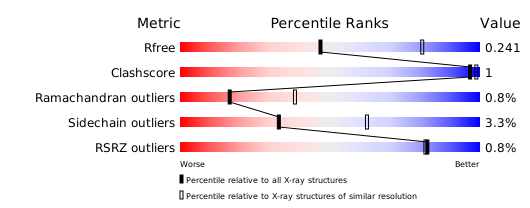
Structure validation
Download full validation report


