






 9F82
9F82
Arbitrium receptor from ATCC13952 phage in complex with GVVRGA peptide
Summary for 9F82
| Entry DOI | 10.2210/pdb9f82/pdb |
| Related | 9F36 |
| Descriptor | Arbitrium receptor from ATCC13952 phage, GLY-VAL-VAL-ARG-GLY-ALA (3 entities in total) |
| Functional Keywords | arbitrium receptor, aimr, aimp, dna binding protein |
| Biological source | Bacillus subtilis More |
| Total number of polymer chains | 8 |
| Total formula weight | 183442.06 |
| Authors | Gallego del Sol, F.,Marina, A. (deposition date: 2024-05-06, release date: 2025-05-21, Last modification date: 2026-05-27) |
| Primary citation | Gallego-Del-Sol, F.,Sin, D.,Chmielowska, C.,Mancheno-Bonillo, J.,Li, Y.,Zamora-Caballero, S.,Quiles-Puchalt, N.,Penades, J.R.,Marina, A. Phages communicate across species to shape microbial ecosystems. Cell, 189:3025-3038.e12, 2026 Cited by PubMed Abstract: Arbitrium is a communication system that helps bacteriophages to decide between lysis and lysogeny through secreted peptides. In this system, the arbitrium communication peptide (AimP) binds its cognate arbitrium receptor (AimR) to repress aimX (a negative regulator of lysogeny) expression, promoting lysogeny. It has been assumed that each AimR responds exclusively to its own AimP. Here, we challenge this view by demonstrating cross-communication between arbitrium systems. Using prototypical arbitrium phages, we show that AimP peptides can bind and repress non-cognate AimR receptors, promoting lysogeny and reducing prophage induction. Structural and biochemical analyses reveal conserved receptor features that permit cross-recognition of non-cognate peptides while preserving recognition of cognate partners. In mixed lysogenic cultures, these interactions alter induction outcomes, underscoring their ecological significance. Extending to infection contexts, we demonstrate that crosstalk favors lysogeny of incoming phages in cells harboring compatible systems. These findings establish that phages engage in cross-species communication via peptide signaling, reshaping microbial communities in unexpected ways. PubMed: 41923642DOI: 10.1016/j.cell.2026.03.004 PDB entries with the same primary citation |
| Experimental method | X-RAY DIFFRACTION (3.1 Å) |
Structure validation
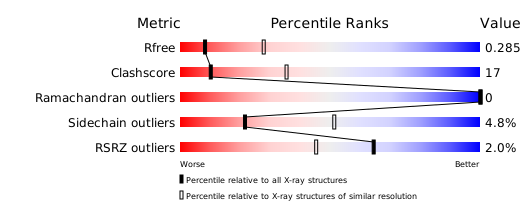
Download full validation report


