






 9EUJ
9EUJ
Cryo-EM structure of Staphylococcus aureus bacteriophage phi812 baseplate in the post-contraction state - sheath initiator, wedge module, inner tripod, arm segment, and proximal tail sheath proteins
Summary for 9EUJ
| Entry DOI | 10.2210/pdb9euj/pdb |
| EMDB information | 19972 |
| Descriptor | Baseplate protein, Major tail sheath protein, Baseplate wedge subunit, ... (6 entities in total) |
| Functional Keywords | bacteriophage, phage, contractile, phi812, baseplate, virus |
| Biological source | Staphylococcus phage 812 More |
| Total number of polymer chains | 14 |
| Total formula weight | 1018230.45 |
| Authors | Binovsky, J.,Siborova, M.,Baska, R.,Pichel-Beleiro, A.,Skubnik, K.,Novacek, J.,van Raaij, M.J.,Plevka, P. (deposition date: 2024-03-27, release date: 2025-04-09, Last modification date: 2026-07-08) |
| Primary citation | Binovsky, J.,Siborova, M.,Zlatohurska, M.,Novacek, J.,Bardy, P.,Baska, R.,Skubnik, K.,Botka, T.,Benesik, M.,Pantucek, R.,Tripsianes, K.,Plevka, P. Conformational changes of the baseplate regulating tail contraction of Staphylococcus phage 812. Embo J., 2026 Cited by PubMed Abstract: Phages with contractile tails employ elaborate mechanisms to penetrate bacterial cell walls and deliver their genomes into the host cytoplasm. Here, we used cryo-EM to show that the baseplate of phage 812, a member of the Kayvirus genus, which infects Gram-positive Staphylococcus strains, is formed of a core, wedge modules, and baseplate arms carrying receptor-binding proteins 1 and 2 and tripod complexes. Upon binding to a host cell, the receptor-binding proteins of phage 812 baseplate reorient and undergo conformational changes. The changes to the tripod complexes trigger the release of the central spike and weld proteins, which expose peptidoglycan-degrading domains of the hub proteins. Changes in the positions of baseplate arms are transmitted through wedge modules to tail sheath initiator proteins. The ring of the tail sheath initiator proteins expands and triggers the contraction of the tail sheath, which shortens to 50% and pushes the tail tube 10-30 nm into the bacterial cytoplasm. Homologous molecular mechanisms are probably shared by phages of the Herelleviridae family with contractile tails to infect Gram-positive bacteria. PubMed: 42350675DOI: 10.1038/s44318-026-00834-9 PDB entries with the same primary citation |
| Experimental method | ELECTRON MICROSCOPY (4 Å) |
Structure validation
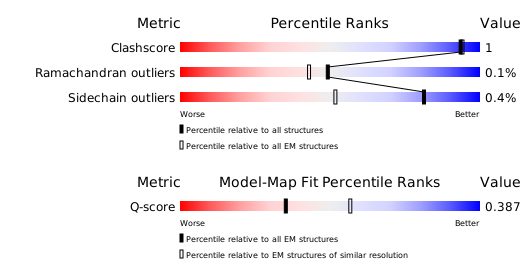
Download full validation report


