






 9EK7
9EK7
Crystal structure of MAIT TCR in complex with MR1-5FdU
Summary for 9EK7
| Entry DOI | 10.2210/pdb9ek7/pdb |
| Descriptor | Major histocompatibility complex class I-related gene protein, SODIUM ION, TCR alpha, ... (11 entities in total) |
| Functional Keywords | receptor, immune system |
| Biological source | Homo sapiens (human) More |
| Total number of polymer chains | 8 |
| Total formula weight | 189619.86 |
| Authors | Awad, W.,Rossjohn, J. (deposition date: 2024-12-01, release date: 2025-05-07, Last modification date: 2025-05-21) |
| Primary citation | Prota, G.,Berloffa, G.,Awad, W.,Vacchini, A.,Chancellor, A.,Schaefer, V.,Constantin, D.,Littler, D.R.,Colombo, R.,Nosi, V.,Mori, L.,Rossjohn, J.,De Libero, G. Mitochondria regulate MR1 protein expression and produce self-metabolites that activate MR1-restricted T cells. Proc.Natl.Acad.Sci.USA, 122:e2418525122-e2418525122, 2025 Cited by PubMed Abstract: Mitochondria coordinate several metabolic pathways, producing metabolites that influence the immune response in various ways. It remains unclear whether mitochondria impact antigen presentation by the MHC-class-I-related antigen-presenting molecule, MR1, which presents small molecules to MR1-restricted T-lymphocytes. Here, we demonstrate that mitochondrial complex III and the enzyme dihydroorotate dehydrogenase are essential for the cell-surface expression of MR1 and for generating uridine- and thymidine-related compounds that bind to MR1 and are produced upon oxidation by reactive oxygen species. One mitochondria-derived immunogenic formylated metabolite we identified is 5-formyl-deoxyuridine (5-FdU). Structural studies indicate that 5-FdU binds in the A'-antigen-binding pocket of MR1, positioning the deoxyribose toward the surface of MR1 for TCR interaction. 5-FdU stimulates specific T cells and detects circulating T cells when loaded onto MR1-tetramers. 5-FdU-reactive cells resemble adaptive T cells and express the phenotypes of naïve, memory, and effector cells, indicating prior in vivo stimulation. These findings suggest that mitochondria may play a role in MR1-mediated immune surveillance. PubMed: 40354545DOI: 10.1073/pnas.2418525122 PDB entries with the same primary citation |
| Experimental method | X-RAY DIFFRACTION (2.15 Å) |
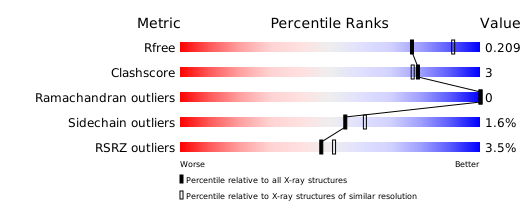
Structure validation
Download full validation report


