






9EBX
Chimeric fluorescence biosensor formed from a lactate-binding protein and GFP
9EBX の概要
| エントリーDOI | 10.2210/pdb9ebx/pdb |
| 関連するPDBエントリー | 9EBW |
| 分子名称 | Green fluorescent protein,Methyl-accepting chemotaxis transducer (TlpC) (2 entities in total) |
| 機能のキーワード | biosensor, binding protein, chimera, fluorescent protein |
| 由来する生物種 | Aequorea victoria 詳細 |
| タンパク質・核酸の鎖数 | 1 |
| 化学式量合計 | 58440.97 |
| 構造登録者 | |
| 主引用文献 | Rosen, P.C.,Horwitz, S.M.,Brooks, D.J.,Kim, E.,Ambarian, J.A.,Waidmann, L.,Davis, K.M.,Yellen, G. State-dependent motion of a genetically encoded fluorescent biosensor. Proc.Natl.Acad.Sci.USA, 122:e2426324122-e2426324122, 2025 Cited by PubMed Abstract: Genetically encoded biosensors can measure biochemical properties such as small-molecule concentrations with single-cell resolution, even in vivo. Despite their utility, these sensors are "black boxes": Very little is known about the structures of their low- and high-fluorescence states or what features are required to transition between them. We used LiLac, a lactate biosensor with a quantitative fluorescence-lifetime readout, as a model system to address these questions. X-ray crystal structures and engineered high-affinity metal bridges demonstrate that LiLac exhibits a large interdomain twist motion that pulls the fluorescent protein away from a "sealed," high-lifetime state in the absence of lactate to a "cracked," low-lifetime state in its presence. Understanding the structures and dynamics of LiLac will help to think about and engineer other fluorescent biosensors. PubMed: 40048274DOI: 10.1073/pnas.2426324122 主引用文献が同じPDBエントリー |
| 実験手法 | X-RAY DIFFRACTION (2.42 Å) |
構造検証レポート
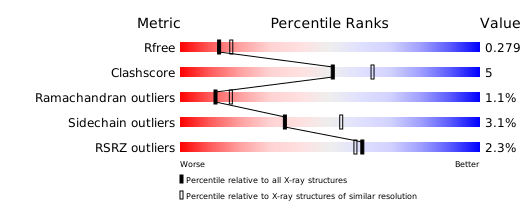
検証レポート(詳細版) をダウンロード
をダウンロード


