






 9E6E
9E6E
Yeast Fzf1 Zn-fingers 1-3 bound to YHB1 26 bp DNA
Summary for 9E6E
| Entry DOI | 10.2210/pdb9e6e/pdb |
| Descriptor | Zinc finger protein FZF1, DNA 1, DNA 2, ... (5 entities in total) |
| Functional Keywords | yeast zn-finger transcriptional activator, dna binding protein, dna binding protein-dna complex, dna binding protein/dna |
| Biological source | Saccharomyces cerevisiae (brewer's yeast) More |
| Total number of polymer chains | 6 |
| Total formula weight | 101674.04 |
| Authors | Moore, S.A.,Ma, C.,Xiao, W. (deposition date: 2024-10-29, release date: 2025-11-05, Last modification date: 2026-02-11) |
| Primary citation | Ma, C.,Du, Y.,Xiao, W.,Moore, S.A. Zinc-finger transcription factor Fzf1 binds to its target DNA in a non-canonical manner. Nucleic Acids Res., 54:-, 2026 Cited by PubMed Abstract: Saccharomyces cerevisiae Fzf1 is a transcriptional regulator with five Cys2His2 zinc fingers, controlling the expression of SSU1, YHB1, DDI2/3, and YNR064C genes through a shared promoter sequence CS2. After exposure to chemicals such as cyanamide (CY) or methyl methanesulfonate (MMS), Fzf1-regulated gene expression increases in yeast cells without concomitant changes in Fzf1 levels, suggesting that chemical modification of Fzf1 leads to increased transcription of target genes. Here, we showed that Fzf1 binds to the four known CS2 promoter sequences with comparable nanomolar affinity, while treatment of Fzf1 with inducing chemicals CY or MMS modestly increased its binding affinity for CS2 sequences. Crystallographic analysis of the N-terminal three zinc fingers of Fzf1 bound to a 26-bp YHB1 CS2 DNA containing the consensus sequence 3'-C3G4T5C6T7G8A9T10A11G12T13-5' reveals non-canonical recognition of duplex DNA for a zinc finger transcription factor. The first zinc finger interacts with the 5'-end dG3' of the standard non-recognition strand, while the second and third fingers read two (3'-T7G8-5') and four (3'-T10A11G12T13-5') adjacent base pairs on the recognition strand, respectively. Recognition of the DNA phosphodiester backbone by Fzf1 mostly resembles other zinc finger proteins. Future work will aim to elucidate how chemical modification of Fzf1 increases transcriptional activation in vivo. PubMed: 41607282DOI: 10.1093/nar/gkag054 PDB entries with the same primary citation |
| Experimental method | X-RAY DIFFRACTION (2.95 Å) |
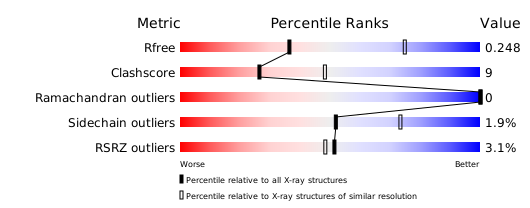
Structure validation
Download full validation report


