






 9DTZ
9DTZSummary for 9DTZ
| Entry DOI | 10.2210/pdb9dtz/pdb |
| Descriptor | 3C-like proteinase nsp5, N-[(2S)-3-cyclopropyl-1-({(2R)-1-imino-3-[(3R)-2-oxopyrrolidin-3-yl]propan-2-yl}amino)-1-oxopropan-2-yl]-4-methoxy-1H-indole-2-carboxamide, SODIUM ION, ... (4 entities in total) |
| Functional Keywords | sars-cov-2 mpro, hydrolase, compound 5, corona virus, aldehyde and nitrile based inhibitors, viral protein, hydrolase-inhibitor complex, hydrolase/inhibitor |
| Biological source | Severe acute respiratory syndrome coronavirus 2 |
| Total number of polymer chains | 2 |
| Total formula weight | 70957.77 |
| Authors | Bigelow, L.,Tang, H.,Boguslaw, N.,Duda, D.M. (deposition date: 2024-10-02, release date: 2025-04-30, Last modification date: 2025-08-06) |
| Primary citation | Padmanabha Das, K.M.,Chen, J.,Charifson, P.S.,Green, J.,Tang, H.,Panchal, S.,Pu, F.,Korepanova, A.,Dubey, A.,Afanador, G.,Stojkovic, V.,Nocek, B.,Bigelow, L.,Stubbs, S.H.,Davey, R.A.,DeGoey, D.A.,Arthanari, H.,Namchuk, M.N. Inhibition of dimeric SARS-CoV-2 Mpro displays positive cooperativity and a mixture of covalent and non-covalent binding. Iscience, 28:112773-112773, 2025 Cited by PubMed Abstract: SARS-CoV-2 Mpro is a cysteine protease that acts as a symmetrical dimer and displays positive cooperativity for substrate turnover. A series of potent reversible covalent peptidomimetic aldehydes and nitriles was designed as Mpro inhibitors. To better understand the observed structure activity relationships (SAR), binding potency and mechanism was examined by enzyme activity assay, surface plasmon resonance, X-ray crystallography, matrix-assisted laser desorption electrospray ionization, and nuclear magnetic resonance (NMR). Potent aldehydes bind Mpro cooperativity but bind covalently to only one subunit of the dimer. The analogous nitriles do not bind cooperatively, and the degree of covalent binding observed varied depending on the assay method employed. The NMR studies support that potent inhibition of Mpro by the nitriles does not require covalent binding. The data highlight the caveats in using orthogonal assays to confirm compound mechanism, particularly in cooperative systems. PubMed: 40655098DOI: 10.1016/j.isci.2025.112773 PDB entries with the same primary citation |
| Experimental method | X-RAY DIFFRACTION (2.2 Å) |
Structure validation
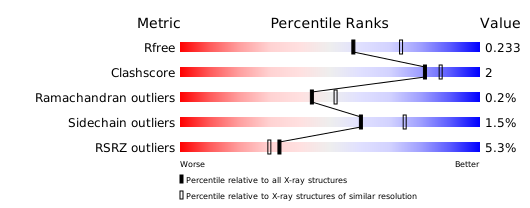
Download full validation report


