






 9DQV
9DQV
Structure of western equine encephalitis virus CBA87 VLP in complex with human PCDH10 EC1
Summary for 9DQV
| Entry DOI | 10.2210/pdb9dqv/pdb |
| EMDB information | 47116 |
| Descriptor | Structural polyprotein, Capsid protein, Protocadherin-10, ... (5 entities in total) |
| Functional Keywords | western equine encephalitis virus, weev, receptor binding, pcdh10, virus like particles, virus like particle |
| Biological source | Western equine encephalitis virus More |
| Total number of polymer chains | 16 |
| Total formula weight | 489054.08 |
| Authors | Abraham, J.,Fan, X.,Li, W. (deposition date: 2024-09-24, release date: 2025-03-26, Last modification date: 2026-04-08) |
| Primary citation | Fan, X.,Li, W.,Oros, J.,Plante, J.A.,Mitchell, B.M.,Plung, J.S.,Basu, H.,Nagappan-Chettiar, S.,Boeckers, J.M.,Tjang, L.V.,Mann, C.J.,Brusic, V.,Buck, T.K.,Varnum, H.,Yang, P.,Malcolm, L.M.,Choi, S.Y.,de Souza, W.M.,Chiu, I.M.,Umemori, H.,Weaver, S.C.,Plante, K.S.,Abraham, J. Molecular basis for shifted receptor recognition by an encephalitic arbovirus. Cell, 188:2957-2973.e28, 2025 Cited by PubMed Abstract: Western equine encephalitis virus (WEEV) is an arbovirus that historically caused large outbreaks of encephalitis throughout the Americas. WEEV binds protocadherin 10 (PCDH10) as a receptor, and highly virulent ancestral WEEV strains also bind low-density lipoprotein receptor (LDLR)-related proteins. As WEEV declined as a human pathogen in North America over the past century, isolates have lost the ability to bind mammalian receptors while still recognizing avian receptors. To explain shifts in receptor dependencies and assess the risk of WEEV re-emergence, we determined cryoelectron microscopy structures of WEEV bound to human PCDH10, avian PCDH10, and human very-low-density lipoprotein receptor (VLDLR). We show that one to three E2 glycoprotein substitutions are sufficient for a nonpathogenic strain to regain the ability to bind mammalian receptors. A soluble VLDLR fragment protects mice from lethal challenge by a virulent ancestral WEEV strain. Because WEEV recently re-emerged in South America after decades of inactivity, our findings have important implications for outbreak preparedness. PubMed: 40187345DOI: 10.1016/j.cell.2025.03.029 PDB entries with the same primary citation |
| Experimental method | ELECTRON MICROSCOPY (3.3 Å) |
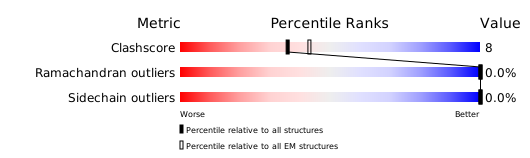
Structure validation
Download full validation report


