






 9DNQ
9DNQ
Structure of UBR2-RYF complex
Summary for 9DNQ
| Entry DOI | 10.2210/pdb9dnq/pdb |
| Related | 9DNO 9DNP 9DNR |
| Descriptor | E3 ubiquitin-protein ligase UBR2, ARG-TYR-PHE-NH2, ZINC ION, ... (4 entities in total) |
| Functional Keywords | ubr, e3 ligase, natural ligands, protein binding |
| Biological source | Homo sapiens (human) More |
| Total number of polymer chains | 4 |
| Total formula weight | 17834.30 |
| Authors | Huang, S.,Wu, J.,Taylor, S.,Chen, Y. (deposition date: 2024-09-17, release date: 2025-08-13, Last modification date: 2026-02-25) |
| Primary citation | Huang, S.T.,Chen, D.H.,Ren, T.,Thomas, N.,Wu, J.,Sankaran, B.,Jones, R.,Taylor, S.,Chen, Y. An alternative pocket for binding the N-degrons by the UBR1 and UBR2 ubiquitin E3 ligases. Protein Sci., 34:e70248-e70248, 2025 Cited by PubMed Abstract: The UBR family of ubiquitin ligases binds to N-termini of their targets (known as N-degron) to induce their ubiquitination and degradation via a conserved domain known as UBR-box. UBR1 and UBR2 share the highest sequence homology among the family, and substantial structural studies were previously performed for substrate binding by the UBR-boxes of UBR1 and UBR2. Here, we describe a new pocket in the UBR-boxes of UBR1 and UBR2 for binding the second residues of N-degrons through determining five co-crystal structures of the UBR-boxes with various N-degron peptides. Together with binding affinities measured by fluorescence polarization, we show that the two highly homologous UBR-boxes can interact with the second residue of an N-degron differently. In addition, the UBR-boxes undergo different conformational changes when binding N-degrons. Furthermore, we demonstrate that the sidechain of the third amino acid of an N-degron has no contribution to binding the UBR-boxes. These findings represent a new conceptual advancement for the UBR E3 ligases and the new insights described here can be leveraged for developing their selective ligands for research and potential therapies. PubMed: 40880185DOI: 10.1002/pro.70248 PDB entries with the same primary citation |
| Experimental method | X-RAY DIFFRACTION (1.22 Å) |
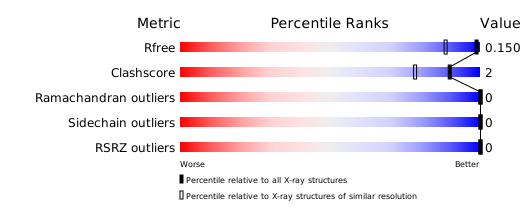
Structure validation
Download full validation report


