






 9DN6
9DN6
Insulin receptor bound with de novo designed agonist called "RF-405".
Summary for 9DN6
| Entry DOI | 10.2210/pdb9dn6/pdb |
| EMDB information | 47031 |
| Descriptor | De novo designed IR agonist RF-405, Isoform Short of Insulin receptor (2 entities in total) |
| Functional Keywords | insulin receptor, de novo designed agonist, signaling protein |
| Biological source | synthetic construct More |
| Total number of polymer chains | 4 |
| Total formula weight | 341235.56 |
| Authors | Bai, X.C. (deposition date: 2024-09-16, release date: 2025-10-01, Last modification date: 2025-11-19) |
| Primary citation | Wang, X.,Cardoso, S.,Cai, K.,Venkatesh, P.,Hung, A.,Ng, M.,Hall, C.,Coventry, B.,Lee, D.S.,Chowhan, R.,Gerben, S.,Li, J.,An, W.,Hon, M.,Gao, M.,Liao, Y.C.,Accili, D.,Choi, E.,Bai, X.C.,Baker, D. Tuning insulin receptor signaling using de novo-designed agonists. Mol.Cell, 85:4064-, 2025 Cited by PubMed Abstract: Insulin binding induces conformational changes in the insulin receptor (IR) that activate the intracellular kinase domain and the protein kinase B (AKT) and mitogen-activated protein kinase (MAPK) pathways, regulating metabolism and proliferation. We reasoned that designed agonists inducing different IR conformational changes might induce different downstream responses. We used de novo protein design to generate binders for individual IR extracellular domains and fused them in different orientations with different conformational flexibility. We obtained a series of synthetic IR agonists that elicit a wide range of receptor autophosphorylation, MAPK activation, trafficking, and proliferation responses. We identified designs more potent than insulin, causing longer-lasting glucose lowering in vivo and retaining activity on disease-causing IR mutants, while largely avoiding the cancer cell proliferation induced by insulin. Our findings shed light on how changes in IR conformation and dynamics translate into downstream signaling, and with further development, our synthetic agonists could have therapeutic utility for metabolic and proliferative diseases. PubMed: 41086805DOI: 10.1016/j.molcel.2025.09.020 PDB entries with the same primary citation |
| Experimental method | ELECTRON MICROSCOPY (4 Å) |
Structure validation
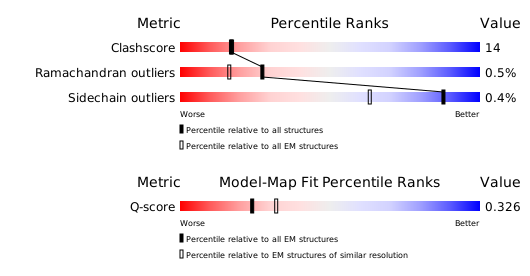
Download full validation report


