






 9DLX
9DLX
Bovine Arp2/3 complex with N-WASP CA bound to Arp3 and Arp2-ArpC1
Summary for 9DLX
| Entry DOI | 10.2210/pdb9dlx/pdb |
| EMDB information | 46992 |
| Descriptor | Actin-related protein 3, MAGNESIUM ION, Actin-related protein 2, ... (10 entities in total) |
| Functional Keywords | actin, arp 2-3 complex, n-wasp, nucleation promoting factor, structural protein |
| Biological source | Homo sapiens (human) More |
| Total number of polymer chains | 9 |
| Total formula weight | 232118.74 |
| Authors | Saks, A.J.,Barrie, K.R.,Dominguez, R. (deposition date: 2024-09-11, release date: 2025-02-12, Last modification date: 2025-08-27) |
| Primary citation | Saks, A.J.,Barrie, K.R.,Rebowski, G.,Dominguez, R. NPF binding to Arp2 is allosterically linked to the release of ArpC5's N-terminal tail and conformational changes in Arp2/3 complex. Proc.Natl.Acad.Sci.USA, 122:e2421557122-e2421557122, 2025 Cited by PubMed Abstract: Arp2/3 complex generates branched actin networks essential for numerous motile functions of the cell. It comprises seven subunits: actin-related proteins (Arps) 2 and 3 and five scaffolding subunits (ArpC1-5). The complex adopts two major conformations: inactive, with the Arps interacting end-to-end, and active, with the Arps aligned side-by-side like subunits in the actin filament. Activation involves several cofactors, including ATP, WASP-family nucleation-promoting factors (NPFs), actin monomers, and the mother actin filament. NPFs bind to two sites, one on Arp2-ArpC1 and one on Arp3, delivering actin subunits at the barbed end of the Arps to initiate branch elongation. However, the mechanisms by which each NPF drives the equilibrium toward activation remain unclear. We present two cryo-electron microscopy (cryo-EM) structures of Arp2/3 complex at 2.9-Å resolution: one with NPFs bound to Arp3 and ArpC1 but not Arp2 and another with NPFs bound to Arp3 and Arp2-ArpC1. The structures reveal that NPF binding to Arp2 is allosterically linked to the release of ArpC5's N-terminal tail from Arp2 and conformational changes in Arp2, including closure of its ATP-binding cleft and partial rotation and translation toward its position in the active complex at the branch. Previous work identified another allosteric switch linking NPF binding to Arp3 with the release of its inhibitory C-terminal tail, which we also observe. In summary, both NPF-binding sites induce allosteric changes in Arp2/3 complex, collectively shifting the equilibrium toward activation. PubMed: 40042350DOI: 10.1073/pnas.2421557122 PDB entries with the same primary citation |
| Experimental method | ELECTRON MICROSCOPY (2.91 Å) |
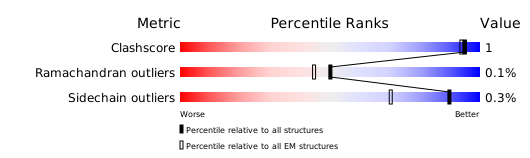
Structure validation
Download full validation report


