






 9DBP
9DBP
Crystal structure of the LSD1/CoREST histone demethylase in complex with the cofactor FAD and the inhibitor GSK690
This is a non-PDB format compatible entry.
Summary for 9DBP
| Entry DOI | 10.2210/pdb9dbp/pdb |
| Descriptor | Lysine-specific histone demethylase 1A, REST corepressor 1, FLAVIN-ADENINE DINUCLEOTIDE, ... (6 entities in total) |
| Functional Keywords | lsd1-corest, histone methyltransferase inhibitor, gene regulation |
| Biological source | Homo sapiens (human) More |
| Total number of polymer chains | 2 |
| Total formula weight | 89445.70 |
| Authors | |
| Primary citation | Wang, Y.,Yu, L.,Deng, K.,Packiarajan, M.,Aguilar, A.,An, S.,Liu, X.,Myers, G.,Oh, H.,Singh, S.A.,Cho, U.S.,Wang, S.,Guan, Y.,White, A.D.,Khoriaty, R.,Engel, J.D. Novel, potent, and orally bioavailable LSD1 inhibitors induce fetal hemoglobin synthesis in a sickle cell disease mouse model. Blood, 146:356-368, 2025 Cited by PubMed Abstract: Small molecules that inhibit LSD1 (lysine-specific demethylase 1, KDM1A) have been shown to induce abundant fetal hemoglobin (HbF) levels in red blood cells both in vitro and in vivo, therefore potentially serving as potent and cost-effective therapeutics to treat the β-globinopathies, sickle cell disease (SCD), and β-thalassemia major (TM). However, most LSD1 inhibitors (LSD1is) that induce HbF in vivo are covalent and irreversible, which leads to adverse effects. In this study, we utilized structure-aided drug design to develop potent new reversible LSD1is, leading to robust γ-globin expression in vitro. Moreover, in a mouse model of SCD, oral administration of these novel inhibitors leads to significant HbF elevation and alleviation of multiple features of disease pathology that are the usual consequences of SCD. In addition, we discovered that combined treatment of an LSD1i with a BRD4 degrader (BD-9136) represses the induction of RUNX1 and PU.1, thereby rescuing the erythroid to myeloid lineage conversion that accompanies LSD1is in hematopoiesis. The data indicate that this new generation of LSD1is can effectively induce HbF levels, reduce SCD pathologies, and are well tolerated by oral administration in SCD mice. We anticipate that the combination of these or related binary compounds offer exciting new therapeutic possibilities for treating SCD and TM. PubMed: 40332031DOI: 10.1182/blood.2024028006 PDB entries with the same primary citation |
| Experimental method | X-RAY DIFFRACTION (2.66 Å) |
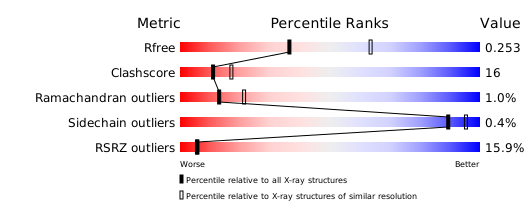
Structure validation
Download full validation report


