






 9D9Z
9D9Z
Structure of human UBR4-KCMF1-CaM E3 ligase complex (Silencing Factor of the Integrated stress response, SiFI)
Summary for 9D9Z
| Entry DOI | 10.2210/pdb9d9z/pdb |
| Related | 9NWD 9NWE |
| EMDB information | 46686 46742 |
| Descriptor | UBR4 (endogenously FLAG-tagged at the N-terminus),E3 ubiquitin-protein ligase UBR4,E3 ubiquitin-protein ligase UBR4,E3 ubiquitin-protein ligase UBR4, Calmodulin-1, E3 ubiquitin-protein ligase KCMF1, ... (5 entities in total) |
| Functional Keywords | e3 liase, ubr4, sifi, ligase |
| Biological source | Homo sapiens (human) More |
| Total number of polymer chains | 6 |
| Total formula weight | 1273520.15 |
| Authors | |
| Primary citation | Yang, Z.,Haakonsen, D.L.,Heider, M.,Witus, S.R.,Zelter, A.,Beschauner, T.,MacCoss, M.J.,Rape, M. Molecular basis of SIFI activity in the integrated stress response. Nature, 643:1117-1126, 2025 Cited by PubMed Abstract: Chronic stress response activation impairs cell survival and causes devastating degenerative diseases. Organisms accordingly deploy silencing factors, such as the E3 ubiquitin ligase silencing factor of the integrated stress response (SIFI), to terminate stress response signalling and ensure cellular homeostasis. How a silencing factor can sense stress across cellular scales to elicit timely stress response inactivation is poorly understood. Here we combine cryo-electron microscopy analysis of endogenous SIFI with AlphaFold modelling and biochemical studies to report the structural and mechanistic basis of the silencing of the integrated stress response. SIFI detects both stress indicators and stress response components through flexible domains within an easily accessible scaffold, before building linkage-specific ubiquitin chains at separate, sterically restricted elongation modules. Ubiquitin handover by a ubiquitin-like domain couples versatile substrate modification to linkage-specific ubiquitin polymer formation. Stress response silencing therefore exploits a catalytic mechanism that is geared towards processing many diverse proteins and therefore allows a single enzyme to monitor and, if needed, modulate a complex cellular state. PubMed: 40328314DOI: 10.1038/s41586-025-09074-z PDB entries with the same primary citation |
| Experimental method | ELECTRON MICROSCOPY (3.4 Å) |
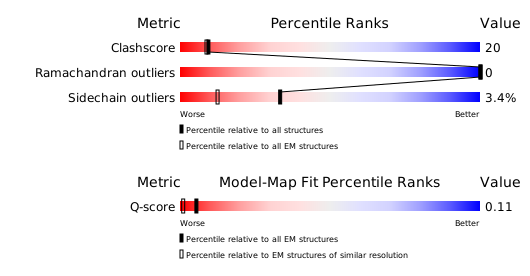
Structure validation
Download full validation report


