






 9CSM
9CSM
Crystal structure of human ribonuclease 7 (RNase 7, HsR7)
Summary for 9CSM
| Entry DOI | 10.2210/pdb9csm/pdb |
| Descriptor | Ribonuclease 7, CHLORIDE ION, ZINC ION, ... (8 entities in total) |
| Functional Keywords | human ribonuclease 7, rnase 7, hsr7, hydrolase, transphosphorylase |
| Biological source | Homo sapiens (human) |
| Total number of polymer chains | 1 |
| Total formula weight | 16221.84 |
| Authors | Tran, T.T.Q.,Pham, N.T.H.,Calmettes, C.,Doucet, N. (deposition date: 2024-07-24, release date: 2025-07-30, Last modification date: 2026-08-12) |
| Primary citation | Tran, T.T.Q.,Larda, S.T.,Nieves, C.,Veyrier, F.J.,Calmettes, C.,Doucet, N. Engineering human RNase 7 with an eosinophil RNase segment reveals determinants of cytotoxic and antimicrobial activity. J.Biol.Chem., 302:113189-113189, 2026 Cited by PubMed Abstract: Human ribonuclease 7 is a potent antimicrobial member of the RNase A superfamily with little cytotoxic activity, in contrast to the closely related eosinophil cationic protein (HsR3). To determine which structural elements underlie these divergent functions, we engineered a chimeric RNase 7 variant in which loop 4 to 5 residues 61 to 77 were replaced by the corresponding segment from HsR3. This chimera acquired cytotoxicity toward HeLa cells while retaining antibacterial activity against Escherichia coli and Mycobacterium smegmatis, identifying this segment as a key transferable determinant of RNase function. Consistent with this result, a peptide spanning HsR3 residues 61 to 77 also displayed antibacterial activity, supporting a direct contribution of this region to host-defense activity and functional modulation within the RNase scaffold. To define the structural basis of RNase 7 activity, we determined crystal structures of RNase 7 in apo and 5'-AMP-bound forms and combined these with NMR titrations and molecular docking. These analyses revealed a canonical RNase fold together with an unexpected adenine-binding pose in the B subsite. Complementary binding analyses showed that RNase 7 preferentially recognizes pyrimidines, yet can also accommodate purine-containing ligands such as UpA in more than one binding mode. Together, these findings establish loop 4 to 5 as a portable functional module that can reprogram biological activity within the human RNase scaffold and provide a structural framework for engineering multifunctional RNases with tailored properties. PubMed: 42203172DOI: 10.1016/j.jbc.2026.113189 PDB entries with the same primary citation |
| Experimental method | X-RAY DIFFRACTION (1.77 Å) |
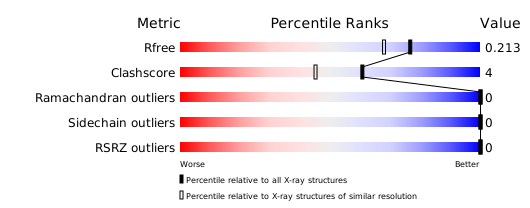
Structure validation
Download full validation report


