






 9CPA
9CPA
Structure of a Mammalian DHX29-bound 43S Pre-initiation Complex
This is a non-PDB format compatible entry.
Summary for 9CPA
| Entry DOI | 10.2210/pdb9cpa/pdb |
| EMDB information | 3057 |
| Descriptor | eL41, Ribosomal protein S13, 40S ribosomal protein S21, ... (51 entities in total) |
| Functional Keywords | translation initiation, scanning, dexh-box rna helicase, translation, ribosome, eif3, eif2 |
| Biological source | Oryctolagus cuniculus (rabbit) More |
| Total number of polymer chains | 51 |
| Total formula weight | 2252905.23 |
| Authors | Cui, D.,des Georges, A. (deposition date: 2024-07-18, release date: 2025-07-23, Last modification date: 2025-08-27) |
| Primary citation | Cui, D.,Pestova, T.,Hellen, C.,des Georges, A. The translation initiation factor DHX29 appears to pull on mRNA in a direction opposite to scanning. Biorxiv, 2025 Cited by PubMed Abstract: The DExH-box helicase DHX29 plays a critical role in mammalian translation initiation. It is required for the scanning of mRNAs with complex 5'UTRs. Despite its importance, the detailed mechanism of DHX29's action has remained debated. Using structural models derived from AlphaFold and cryo-EM structure of DHX29 bound to the ribosomal 43S pre-initiation complex, we provide a revised structural framework that clarifies the interplay between DHX29, the 40S ribosomal subunit, and eIF3. Our findings suggest that the 40S subunit regulates DHX29's NTPase activity through an activation mechanism resembling the G-patch protein regulation of DEAH helicases. Moreover, our model supports a 3' to 5' translocase mechanism, in which DHX29 transiently pulls the mRNA opposite to the scanning direction, destabilizing stable stem-loops trapped in the mRNA channel and allowing scanning to resume. This structural analysis refines our understanding of DHX29's function and provides new hypotheses regarding its role in mRNA unwinding during scanning and start codon selection. PubMed: 40791316DOI: 10.1101/2025.07.13.664561 PDB entries with the same primary citation |
| Experimental method | ELECTRON MICROSCOPY (6 Å) |
Structure validation
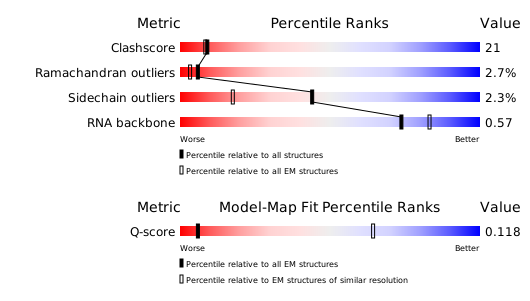
Download full validation report


