






 9OS2
9OS2
Cryo-EM structure of the DDB1/CRBN-MRT-5702-G3BP2 ternary complex
This is a non-PDB format compatible entry.
Summary for 9OS2
| Entry DOI | 10.2210/pdb9os2/pdb |
| EMDB information | 70791 |
| Descriptor | Protein cereblon, DNA damage-binding protein 1, Ras GTPase-activating protein-binding protein 2, ... (5 entities in total) |
| Functional Keywords | molecular glue degrader, neo-substrate, cereblon, e3 ubiquitin ligase, ligase |
| Biological source | Homo sapiens (human) More |
| Total number of polymer chains | 4 |
| Total formula weight | 279734.21 |
| Authors | Quan, C.,Petzold, G.,Gainza, P.,Tsai, J.,Bunker, R.D.,Wiedmer, L.,Donckele, E.J. (deposition date: 2025-05-23, release date: 2026-01-28, Last modification date: 2026-04-01) |
| Primary citation | Annunziato, S.,Quan, C.,Donckele, E.J.,Lamberto, I.,Bunker, R.D.,Zlotosch, M.,Schwander, L.,Murthy, A.,Wiedmer, L.,Staehly, C.,Matysik, M.,Gilberto, S.,Kapsitidou, D.,Wible, D.,De Donatis, G.M.,Trenh, P.,SriRamaratnam, R.,Strande, V.,Lieberherr, R.,Lyon, D.,Steiner, D.,Silva, J.,Almeida, R.,Dolgikh, E.,DeMarco, B.,Tsai, J.,Sadok, A.,Zarayskiy, V.,Walter, M.,Tiedt, R.,Lumb, K.J.,Bonenfant, D.,Fasching, B.,Castle, J.C.,Townson, S.A.,Gainza, P.,Petzold, G. Cereblon induces G3BP2 neosubstrate degradation using molecular surface mimicry. Nat.Struct.Mol.Biol., 33:479-487, 2026 Cited by PubMed Abstract: Molecular glue degraders (MGDs) are small-molecule compounds that divert E3 ligases to degrade nonnatural substrates called neosubstrates. Clinically effective MGDs bind cereblon (CRBN), a substrate receptor of the Cullin 4-RING E3 ubiquitin ligase (CRL4), and recruit neosubstrates to an MGD-induced neosurface on the CRBN CULT domain through molecular mimicry of a natural CRBN degron. Here, we identify G3BP2 (Ras-GAP SH3 domain-binding protein 2), a neosubstrate that bypasses canonical interactions with CRBN by engaging an unconventional binding site on the CRBN LON domain. The ternary complex interface does not resemble known interactions with CRBN. Instead, CRBN leverages a preexisting protein-protein interaction (PPI) hotspot on the target protein by mimicking an endogenous binding partner of G3BP2. Our findings suggest that composite neosurfaces that mimic and stabilize the footprint of natural PPIs (in short, 'glueprints') could become a viable strategy for the rational expansion of the MGD target repertoire. PubMed: 41559416DOI: 10.1038/s41594-025-01738-8 PDB entries with the same primary citation |
| Experimental method | ELECTRON MICROSCOPY (2.5 Å) |
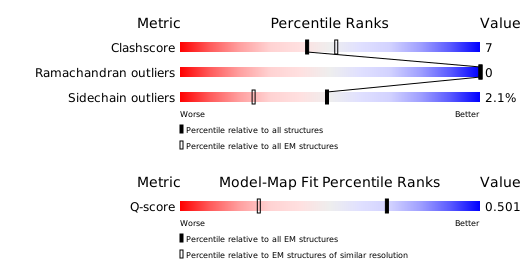
Structure validation
Download full validation report


