






 9MXL
9MXL
Complex of the phosphorylated human cystic fibrosis transmembrane conductance regulator (CFTR) with (R)-BPO-27 and ATP/Mg
This is a non-PDB format compatible entry.
Summary for 9MXL
| Entry DOI | 10.2210/pdb9mxl/pdb |
| EMDB information | 48717 |
| Descriptor | Cystic fibrosis transmembrane conductance regulator, (6R,12R)-6-(5-bromofuran-2-yl)-7,9-dimethyl-8,10-dioxo-11-phenyl-7,8,9,10-tetrahydro-6H-pyrimido[4',5':3,4]pyrrolo[2,1-c][1,4]benzoxazine-2-carboxylic acid, MAGNESIUM ION, ... (6 entities in total) |
| Functional Keywords | inhibitor, cftr, membrane protein |
| Biological source | Homo sapiens (human) |
| Total number of polymer chains | 1 |
| Total formula weight | 169981.24 |
| Authors | Young, P.G.,Fiedorczuk, K.,Chen, J. (deposition date: 2025-01-20, release date: 2025-08-06, Last modification date: 2026-02-18) |
| Primary citation | Young, P.G.,Fiedorczuk, K.,Chen, J. Structure of CFTR bound to (R)-BPO-27 unveils a pore-blockage mechanism. Nat Commun, 16:7059-7059, 2025 Cited by PubMed Abstract: Hyperactivation of the cystic fibrosis transmembrane conductance regulator (CFTR) contributes to secretory diarrhea, a major cause of pediatric mortality worldwide, and autosomal dominant polycystic kidney disease (ADPKD), the most common inherited cause of end-stage renal disease. Selective CFTR inhibition is a potential therapeutic strategy, with (R)-BPO-27 emerging as a promising candidate. Here, we present a cryo-EM structure of CFTR bound to (R)-BPO-27 at an overall resolution of 2.1 Å. Contrary to the previous hypothesis that it inhibits CFTR current by competition with ATP, we demonstrate that (R)-BPO-27 instead directly occludes the chloride-conducting pore while permitting ATP hydrolysis, thus uncoupling the two activities. Furthermore, we find that inhibitor binding requires some degree of NBD separation, as the inhibition rate inversely correlates with the probability NBD dimerization. These findings clarify the compound's mechanism and provide a molecular basis for optimizing its clinical potential. PubMed: 40750590DOI: 10.1038/s41467-025-62199-7 PDB entries with the same primary citation |
| Experimental method | ELECTRON MICROSCOPY (2.1 Å) |
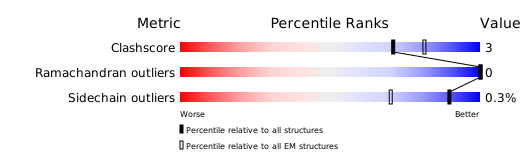
Structure validation
Download full validation report


