






 8ZK0
8ZK0
Cryo-EM structure of the full length pAg-bound BTN2A1-BTN3A1-BTN3A2 in complex with Vgamma9-Vdelta2 TCR (G115 genotype)
Summary for 8ZK0
| Entry DOI | 10.2210/pdb8zk0/pdb |
| EMDB information | 60162 |
| Descriptor | Butyrophilin subfamily 2 member A1, T cell receptor delta variable 2, T cell receptor delta constant 1, T cell receptor gamma variable 9, T cell receptor gamma constant 1, ... (6 entities in total) |
| Functional Keywords | receptor, immune system |
| Biological source | Homo sapiens (human) More |
| Total number of polymer chains | 6 |
| Total formula weight | 273725.62 |
| Authors | |
| Primary citation | Xin, W.,Huang, B.,Gao, W.,Zhang, W.,Hu, Y.,Liu, Y.,Liang, E.,Chen, J.,Shi, Y.,Su, Q.,Zhou, Q. Phosphoantigen-driven dissociation of butyrophilin oligomers activates gamma delta T cells. Cell Discov, 12:-, 2026 Cited by PubMed Abstract: γδ T cells represent a promising avenue for cancer immunotherapy. The Vγ9Vδ2 T-cell receptor (TCR), which is expressed by the predominant subset of γδ T cells, responds to phosphoantigen (pAg)-engaged butyrophilins (BTNs) on various cancer cells. However, the molecular mechanism underlying the pAg-mediated activation of Vγ9Vδ2 TCRs remains a subject of debate. Here, we employed an integrative approach to elucidate the mechanism of pAg reactivity in Vγ9Vδ2 T cells. Our results demonstrate that BTNs form higher-order oligomers in the absence of pAg. Upon pAg binding, these higher-order oligomers dissociate into separate tetramers, enabling Vγ9Vδ2 TCR engagement. This pAg-induced dissociation of higher-order BTN oligomers is critical for pAg-mediated activation of γδ T cells. Our findings reveal a mechanism of BTN higher-order oligomer dissociation-driven pAg sensing, providing valuable insight for future immunotherapeutic strategies. PubMed: 42575881DOI: 10.1038/s41421-026-00911-7 PDB entries with the same primary citation |
| Experimental method | ELECTRON MICROSCOPY (3.4 Å) |
Structure validation
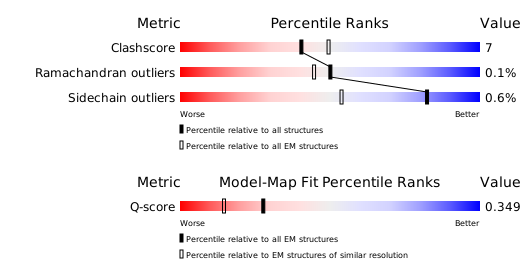
Download full validation report


