






 8ZE8
8ZE8
Arf-GTPase activating protein Asap1 SH3 domain in complex with 440 Kd Ankyrin-B fragment
Summary for 8ZE8
| Entry DOI | 10.2210/pdb8ze8/pdb |
| Descriptor | Arf-GAP with SH3 domain, ANK repeat and PH domain-containing protein 1, Ankyrin-2, GLYCEROL, ... (4 entities in total) |
| Functional Keywords | complex, protein binding |
| Biological source | Mus musculus (house mouse) More |
| Total number of polymer chains | 8 |
| Total formula weight | 37101.93 |
| Authors | |
| Primary citation | Li, Y.,Zhao, Y.,He, Y.,Liu, F.,Xia, L.,Liu, K.,Zhang, M.,Chen, K. New targets and designed inhibitors of ASAP Arf-GAPs derived from structural characterization of the ASAP1/440-kD ankyrin-B interaction. J.Biol.Chem., 300:107762-107762, 2024 Cited by PubMed Abstract: ASAP1 and its paralog ASAP2 belong to a PIP-dependent Arf GTPase-activating protein (Arf-GAP) family capable of modulating membrane and cytoskeletal dynamics. ASAPs regulate cell adhesive structures such as invadosomes and focal adhesions during cell attachment and migration. Malfunctioning of ASAP1 has been implicated in the malignant phenotypes of various cancers. Here, we discovered that the SH3 domain of ASAP1 or ASAP2 specifically binds to a 12-residue, positively charged peptide fragment from the 440 kDa giant ankyrin-B, a neuronal axon specific scaffold protein. The high-resolution structure of the ASAP1-SH3 domain in complex with the gAnkB peptide revealed a noncanonical SH3-ligand binding mode with high affinity and specificity. Structural analysis of the complex readily uncovered a consensus ASAP1-SH3 binding motif, which allowed the discovery of a number of previously unknown binding partners of ASAP1-SH3 including Clasp1/Clasp2, ALS2, β-Pix, DAPK3, PHIP, and Limk1. Fittingly, these newly identified ASAP1 binding partners are primarily key modulators of the cytoskeletons. Finally, we designed a cell-penetrating, highly potent ASAP1 SH3 domain binding peptide with a K ∼7 nM as a tool for studying the roles of ASAPs in different cellular processes. PubMed: 39265663DOI: 10.1016/j.jbc.2024.107762 PDB entries with the same primary citation |
| Experimental method | X-RAY DIFFRACTION (2.07 Å) |
Structure validation
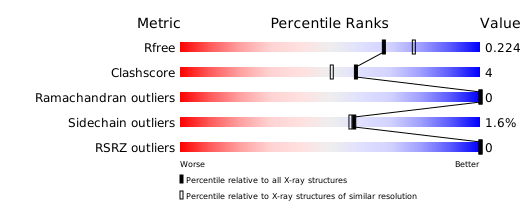
Download full validation report


