






 8Z9P
8Z9P
Cryo-EM structure of human GPR4-Gi complex
Summary for 8Z9P
| Entry DOI | 10.2210/pdb8z9p/pdb |
| EMDB information | 39866 |
| Descriptor | Guanine nucleotide-binding protein G(I)/G(S)/G(T) subunit beta-1, Guanine nucleotide-binding protein G(I)/G(S)/G(O) subunit gamma-2, G-protein coupled receptor 4, ... (6 entities in total) |
| Functional Keywords | gpcr, class a, gpr4-gi, cryo-em, protein sensing, active state, membrane protein |
| Biological source | Rattus norvegicus (Norway rat) More |
| Total number of polymer chains | 5 |
| Total formula weight | 148100.94 |
| Authors | Chen, L.N.,Zhou, H.,Xi, K.,Cheng, S.Z.,Liu, Y.F.,Fu, Y.F.,Ma, X.Y.,Xu, P.,Ji, S.Y.,Wang, W.W.,Shen, D.D.,Zhang, H.B.,Shen, Q.Y.,Chai, R.,Zhang, M.,Yang, L.,Han, F.,Mao, C.Y.,Cai, X.J.,Zhang, Y. (deposition date: 2024-04-23, release date: 2025-07-09, Last modification date: 2026-01-14) |
| Primary citation | Chen, L.N.,Zhou, H.,Xi, K.,Cheng, S.,Liu, Y.,Fu, Y.,Ma, X.,Xu, P.,Ji, S.Y.,Wang, W.W.,Shen, D.D.,Zhang, H.,Shen, Q.,Chai, R.,Zhang, M.,Yang, L.,Han, F.,Mao, C.,Cai, X.,Zhang, Y. Proton perception and activation of a proton-sensing GPCR. Mol.Cell, 85:1640-1657.e8, 2025 Cited by PubMed Abstract: Maintaining pH at cellular, tissular, and systemic levels is essential for human health. Proton-sensing GPCRs regulate physiological and pathological processes by sensing the extracellular acidity. However, the molecular mechanism of proton sensing and activation of these receptors remains elusive. Here, we present cryoelectron microscopy (cryo-EM) structures of human GPR4, a prototypical proton-sensing GPCR, in its inactive and active states. Our studies reveal that three extracellular histidine residues are crucial for proton sensing of human GPR4. The binding of protons induces substantial conformational changes in GPR4's ECLs, particularly in ECL2, which transforms from a helix-loop to a β-turn-β configuration. This transformation leads to the rearrangements of H-bond network and hydrophobic packing, relayed by non-canonical motifs to accommodate G proteins. Furthermore, the antagonist NE52-QQ57 hinders human GPR4 activation by preventing hydrophobic stacking rearrangement. Our findings provide a molecular framework for understanding the activation mechanism of a human proton-sensing GPCR, aiding future drug discovery. PubMed: 40215960DOI: 10.1016/j.molcel.2025.02.030 PDB entries with the same primary citation |
| Experimental method | ELECTRON MICROSCOPY (2.5 Å) |
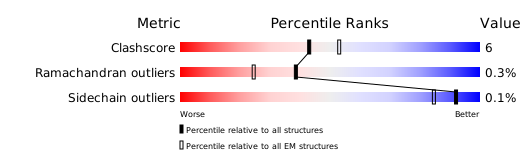
Structure validation
Download full validation report


