






 8YMC
8YMC
FtsEX in nanodisc
Summary for 8YMC
| Entry DOI | 10.2210/pdb8ymc/pdb |
| EMDB information | 39394 |
| Descriptor | Cell division ATP-binding protein FtsE, Cell division protein FtsX, ADENOSINE-5'-TRIPHOSPHATE, ... (4 entities in total) |
| Functional Keywords | ftse, ftsx, gram-negative bacteria, cell division, membrane protein |
| Biological source | Escherichia coli K-12 More |
| Total number of polymer chains | 4 |
| Total formula weight | 127168.34 |
| Authors | |
| Primary citation | Chen, Y.,Guo, D.,Wang, X.,Zhang, C.,Chen, Y.,Luo, Q.,Chen, Y.,Yang, L.,Zhang, Z.,Hong, T.,Zhang, Z.,Dong, H.,Chang, S.,Hu, J.,Tang, X. Structural insights into the mechanotransducing mechanism of FtsEX in cell division. MedComm (2020), 5:e688-e688, 2024 Cited by PubMed Abstract: The filamentous temperature-sensitive (Fts) protein FtsEX plays a pivotal role in () cell division by facilitating the activation of peptidoglycan hydrolysis through the adaptor EnvC. FtsEX belongs to the type VII ATP-binding cassette (ABC) transporter superfamily, which harnesses ATP energy to induce mechanical force, triggering a cascade of conformational changes that activate the pathway. However, the precise mechanism by which FtsEX initiates mechanotransmission remains elusive. Due to the inherent instability of this type of ABC transporter protein in vitro, the conformation of FtsEX has solely been determined in the stabilized ATP-bound state. To elucidate the dynamics of FtsEX, we characterized FtsEX and EnvC of various functional structures through cryo-electron microscopy (cryo-EM) and homology modeling. We validated the structures by molecular dynamics simulations. By site-directed mutagenesis and phenotype screening, we also identified the functional residues involved in allosteric communication between FtsE and FtsX as well as FtsX and EnvC. Additionally, we discovered a potential role of phospholipids in stabilizing the complex conformation during mechanotransmission. This comprehensive exploration significantly enhances our understanding of the intricate mechanisms governing bacterial cell division and unveils potential molecular targets for developing innovative antimicrobial drugs to combat antibiotic resistance. PubMed: 39434966DOI: 10.1002/mco2.688 PDB entries with the same primary citation |
| Experimental method | ELECTRON MICROSCOPY (2.7 Å) |
Structure validation
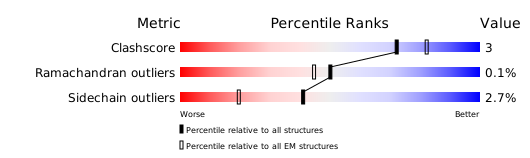
Download full validation report


