






 8YGQ
8YGQ
Crystal structure of Human TEAD2 in complex with Cobimetinib
Summary for 8YGQ
| Entry DOI | 10.2210/pdb8ygq/pdb |
| Descriptor | Transcriptional enhancer factor TEF-4, PALMITIC ACID, [3,4-BIS(FLUORANYL)-2-[(2-FLUORANYL-4-IODANYL-PHENYL)AMINO]PHENYL]-[3-OXIDANYL-3-[(2S)-PIPERIDIN-2-YL]AZETIDIN-1-YL]METHANONE (3 entities in total) |
| Functional Keywords | hippo pathway, tead inhibitor, transcription |
| Biological source | Homo sapiens (human) |
| Total number of polymer chains | 2 |
| Total formula weight | 52246.11 |
| Authors | |
| Primary citation | Yang, R.,Hu, L.,Wang, J.,Wang, J.,Yuan, L.,Wu, M.,He, L.,Yu, W.,Chen, P.,Lu, X.,Hu, F.,Zhang, H.,Gao, H.,Wang, X.,Zhang, H.,Sun, Y.,Xu, J.,Huang, J.,Zhou, H.,Zhu, J.,Wei, F.,Jin, Y.,Gao, Y.,Fu, Q.,Qi, X.,Yu, J.,Li, P.,He, X.,Zhang, L. Phase separation-based HTS identifies cobimetinib as a YAP-TEAD inhibitor that suppresses hyperactivated YAP-induced cancer progression. Sci Transl Med, 18:eadu0814-eadu0814, 2026 Cited by PubMed Abstract: The Hippo signaling pathway prevents unchecked cell growth, coordinates apoptosis, and preserves proper organ function. Dysregulation of this pathway has been implicated in a myriad of diseases, particularly in cancer. The YAP (Yes-associated protein)-TEAD (TEA domain transcription factor) complex, the key transcriptional downstream effector of the Hippo pathway, hence stands out as an appealing target for therapeutic intervention. In this study, we developed a high-throughput screening (HTS) assay leveraging phase separation principles and found that the US Food and Drug Administration-approved clinical drug cobimetinib is a potent inhibitor of the YAP-TEAD complex. Cocrystallization studies of cobimetinib with TEAD showed that cobimetinib bound to the TEAD lipid pocket and disrupted TEAD palmitoylation. Cobimetinib could overcome resistance to mitogen-activated protein kinase kinase 1/2 inhibitors and to the first-line drug sorafenib in vivo. In addition, cobimetinib suppressed tumor growth and tumorigenesis associated with hyperactivated YAP-TEAD activities in a mouse model of lung cancer. Furthermore, it bolstered the efficacy of the first-line drugs sorafenib and lenvatinib in inhibiting both hepatocellular carcinoma tumor growth and tumorigenesis. These findings establish a strategy for identifying and refining inhibitors of the YAP-TEAD complex in the treatment of cancers driven by aberrant YAP-TEAD activity. PubMed: 42018668DOI: 10.1126/scitranslmed.adu0814 PDB entries with the same primary citation |
| Experimental method | X-RAY DIFFRACTION (2.71 Å) |
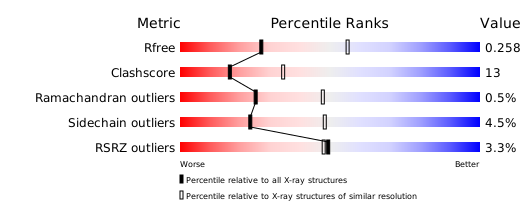
Structure validation
Download full validation report


