






 8XO1
8XO1Summary for 8XO1
| Entry DOI | 10.2210/pdb8xo1/pdb |
| EMDB information | 38522 |
| Descriptor | Potassium voltage-gated channel subfamily KQT member 2, Calmodulin-1, ~{N}-[2-azanyl-3-fluoranyl-4-[[4-(trifluoromethyl)phenyl]methylamino]phenyl]-3-cyclopentyl-propanamide (3 entities in total) |
| Functional Keywords | kcnq2, human voltage-gated potassium channel, membrane protein |
| Biological source | Homo sapiens (human) More |
| Total number of polymer chains | 8 |
| Total formula weight | 453010.94 |
| Authors | Zhao, Y.W.,Yang, Z.N.,Guo, J.T.,Du, X.N. (deposition date: 2023-12-31, release date: 2025-01-01, Last modification date: 2026-01-21) |
| Primary citation | Zhao, Y.,Yang, Z.,Shi, S.,Hao, H.,Li, X.,Ma, D.,Su, N.,Zhao, W.,Shao, J.,An, Y.,Wang, K.,Liu, Y.,Zou, L.,Qi, J.,Zhang, H.,Guo, J.,Du, X. Structure basis for the activation of KCNQ2 by endogenous and exogenous ligands. Cell Rep, 45:116771-116771, 2025 Cited by PubMed Abstract: The voltage-gated potassium channel KCNQ2 is crucial for stabilizing neuronal membrane potential, and its mutations can cause various epilepsies. KCNQ2 is activated by endogenous ligand phosphatidylinositol-4,5-bisphosphate (PIP) and exogenous ligands, yet the structural mechanisms underlying these activations remain unclear. Here, we report the cryo-electron microscopy structures of human KCNQ2 in complex with exogenous ligands QO-58 and QO-83 in the absence or presence of PIP in either closed or open conformation. While QO-83 binds in the classical fenestration pocket of the pore domain, QO-58 mainly binds at the flank of S4 in the voltage-sensing domain. These structures, along with electrophysiological assays and computational studies, provide mechanistic insights into the ligand activation of KCNQ2 and may guide the development of anti-epileptic drugs targeting KCNQ2. PubMed: 41442279DOI: 10.1016/j.celrep.2025.116771 PDB entries with the same primary citation |
| Experimental method | ELECTRON MICROSCOPY (3.8 Å) |
Structure validation
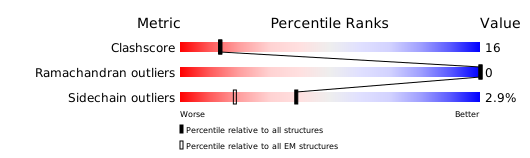
Download full validation report


