






 8W39
8W39Summary for 8W39
| Entry DOI | 10.2210/pdb8w39/pdb |
| Descriptor | SmcR, (3S)-3-phenyl-1-[(2R)-thiolane-2-sulfonyl]pyrazolidine (3 entities in total) |
| Functional Keywords | inhibitor, transcription factor, quorum-sensing receptor, dna binding protein |
| Biological source | Vibrio vulnificus |
| Total number of polymer chains | 2 |
| Total formula weight | 46981.70 |
| Authors | Paczkowski, J.E.,Brockley, M.W.,van Kessel, J.C. (deposition date: 2024-02-22, release date: 2025-02-26, Last modification date: 2026-03-11) |
| Primary citation | Rasal, T.A.,Mallery, C.P.,Liang, B.,Brockley, M.W.,Simpson, C.A.,Padgett, A.D.,Geyman, L.J.,Andrew, F.J.,Brown, L.C.,Paczkowski, J.E.,van Kessel, J.C. Ligand binding drives proteolysis of the SmcR master transcription factor and controls quorum sensing-state transitions in Vibrio species. Mbio, :e0344525-e0344525, 2026 Cited by PubMed Abstract: In species, quorum sensing signaling culminates in the production of the master transcription factor SmcR that regulates group behavior genes in a density-dependent manner. Previously, we identified a small-molecule thiophenesulfonamide inhibitor called PTSP [3-phenyl-1-(thiophen-2-ylsulfonyl)-1-pyrazole] that targets the SmcR family of proteins in multiple species and blocks activity . Here, we used structure-function analyses to identify eight PTSP-interacting residues in the ligand-binding pocket that are required for PTSP inhibition of SmcR. Binding of PTSP to SmcR drives allosteric unfolding of the N-terminal DNA-binding domain, and, in this state, SmcR is specifically degraded by the ClpAP protease. This mechanism of PTSP inhibition was observed for all thiophenesulfonamide compounds tested against as well as and . We show that cells expressing degradation-resistant alleles are impervious to changes in cell density state. These studies implicate ligand binding as a mediator of SmcR protein stability and function, which dictates the timing of quorum-sensing gene expression in three pathogens.IMPORTANCESmcR family proteins were discovered in the 1990s as central regulators of quorum-sensing gene expression and later discovered to be conserved in all studied species. SmcR homologs regulate a wide range of genes involved in pathogenesis, including but not limited to genes involved in biofilm production and toxin secretion. As archetypal members of the broad class of TetR-type transcription factors, each SmcR-type protein has a predicted ligand-binding pocket. However, no native ligand has been identified for these proteins that control their function as regulators. Here, we used SmcR-specific chemical inhibitors to determine that ligand binding drives proteolytic degradation , providing the first demonstration of SmcR function connected to ligand binding for this historical protein family. PubMed: 41615159DOI: 10.1128/mbio.03445-25 PDB entries with the same primary citation |
| Experimental method | X-RAY DIFFRACTION (2.1 Å) |
Structure validation
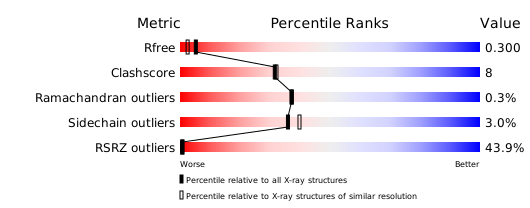
Download full validation report


